






Time travel movies that take themselves seriously are often doomed to failure because it’s pretty much impossible to write a story about time travel that doesn’t have massive contradictions or paradoxes. The exception is Primer, a 2004 independent film made for around $7,000. Primer doesn’t have big stars or any special effects to speak of, but it does have the most scientifically literate script of any movie about time travel ever written, which is more than enough.
Heaven help us while we try to explain the plot of Primer
Beware headaches and potential spoilers
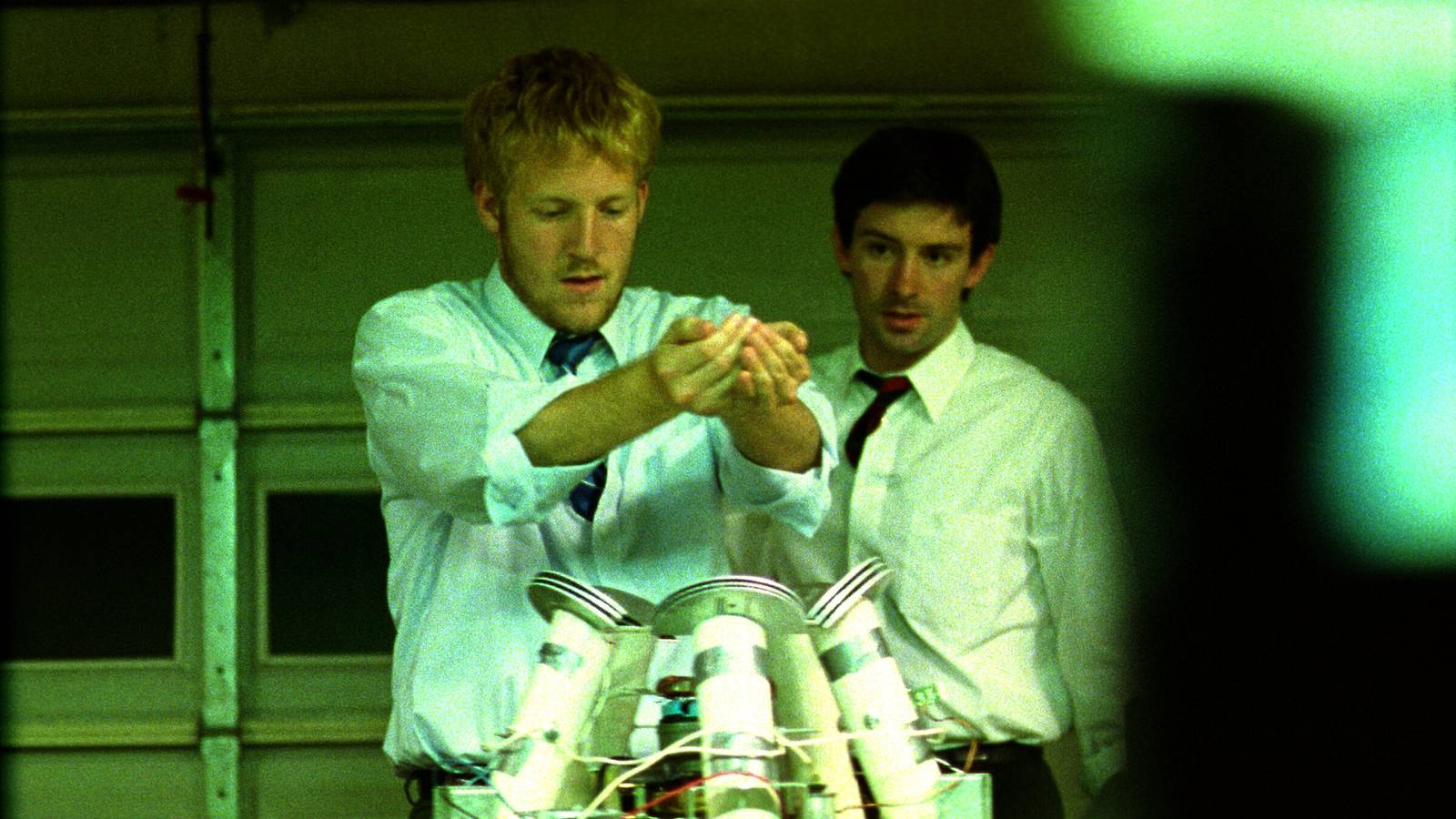
Primer is about a pair of engineers, Aaron (Shane Carruth) and Abe (David Sullivan), who tinker in Aaron’s garage, trying to invent things when not at their day jobs. One day, they’re working on a sort of anti-gravity device when they discover that they may have accidentally invented time travel. After they see that they can send small objects short distances back in time in a loop, Abe builds a box big enough to send a person back in time, although they can’t travel back any further than when the box was first created. He tells Aaron about it on his first trip back, and the two start traveling back in time together by several hours and buying stocks they know will rise in value by the end of the day. If a time travel machine actually existed, this is 100% what people would first think to do with it, so I give Primer points for realism.
The movie tries to keep everything grounded like that. For instance, before their trips back in time, Aaron and Abe isolate themselves in a hotel room for hours to eliminate the possibility of running into themselves later and creating a world-melting paradox. But inevitably, things start to spin out of control. A man they know named Thomas Granger shows up disoriented and disheveled, which is weird because he’s also answering his phone at home. So there are now two Thomas Grangers; Abe deduces that at some point in the future, Thomas must have used a time travel box, which Abe takes as a sign that this is all getting out of hand. Happily, Abe built a “fail-safe” box that can take him back in time to after he built his first human-sized time travel box but before he started using it; that way, he can sabotage the boxes, meaning his former self will think time travel doesn’t work, and none of this will have happened.
However, when Abe uses the fail-safe box, he finds that things have been compromised, and that’s about all I can say without seriously spoiling things and/or revealing that I still don’t understand the plot of this movie despite having had multiple decades to think about it.
Primer is smarter than it is confusing
The line can be thin sometimes
Because Primer has such a small budget, it can’t afford to distract us with pyrotechnics or action scenes. If it’s going to be compelling, it has to be written incredibly tightly, which it is. The above chart, made by the Redditor Clawz114, purports to break it down. That’s a plot complicated enough to keep people obsessing for years.
In addition to playing Aaron, Shane Carruth also wrote and directed Primer, and he brings serious credentials. He was a mathematician and programmer before becoming a filmmaker, and studied theoretical physics before making Primer to ensure that the concepts and dialogue held up to scrutiny. As a non-physicist myself, I can’t attest to whether he was fully successful, but the dialogue in Primer certainly sounds more grounded in actual fact and theory than that of your average time travel movie. There’s no Star Trek-style “reverse the polarity of the neutron flow”-esque talk here. Watching Primer could educate you a little on some high-level scientific concepts, or at least intrigue you enough to look into them further.
But the movie isn’t all about cold, hard science. At its heart, it’s about a friendship that gets torn apart as these two engineers start having conflicting thoughts and feelings about what should be done with this groundbreaking technology. Despite all the technical language, Primer has a real emotional core. It’s also about the horror of realizing how little we understand the universe. Aaron and Abe crack time travel, one of the greatest accomplishments in history, but as the complications pile up, they realize they’re completely out of their depth.
Okay, SOME people talk about Primer
What is a time loop?
Let me head off some potential criticisms: Is Primer really a time loop movie? It’s not a time loop movie in the same sense that, say, Groundhog Day is, where the main character relives the same day over and over. But in Primer, the characters keep choosing to work through the same span of hours multiple times, even as living through them again changes them, so I think it counts.
There are other time travel movies out there that try to get the science right, but when it comes to realism, I think Primer beats out even heavy hitters like Interstellar. And for a movie that was made for so little money, it doesn’t look cheap. If you don’t mind a bit of challenge, it’s a great watch. And it’s one of several great movies on the short side, so you’ll have plenty of time afterwards to think about it.

What is popular?
I’ll admit it’s a bit of an exaggeration to say that “no one” talks about Primer. It made less than a million dollars at the box office, so it wasn’t a big hit when it came out, although that’s obviously an excellent return considering the tiny budget. But it did find a cult audience afterwards, and people are still discovering it to this day.
But you know what? Not nearly enough people talk about it. Primer isn’t a beloved movie classic like Groundhog Day or a Hollywood blockbuster like Source Code, Looper, or Edge of Tomorrow, all great time loop movies I recommend. And if you watch those and your brain still needs melting, check out some of these sci-fi TV shows.

- Release Date
-
October 8, 2004
- Runtime
-
77 minutes
- Director
-
Shane Carruth
- Writers
-
Shane Carruth