







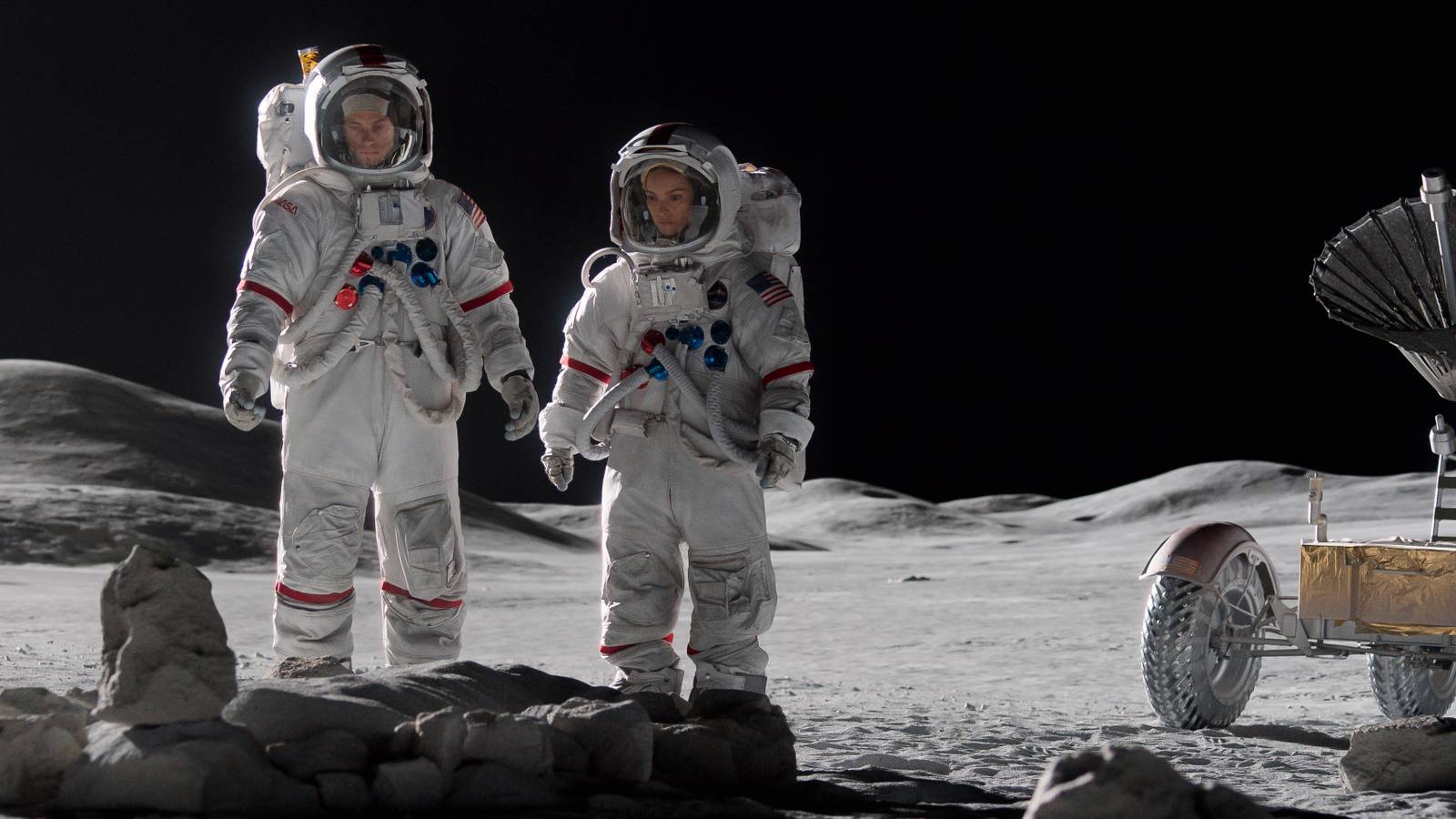
Science fiction is a wide umbrella. Sci-fi shows like Pluribus and Severance are fantastic, but they’re not overly concerned with whether the far-flung concepts they come up with are actually plausible; the sci-fi ideas are mostly excuses to get to the human story. Then there’s a show like The Expanse, which does its best to tell a sci-fi story with aliens and interplanetary travel that still mostly adheres to the actual laws of physics.
For All Mankind, a show on Apple TV+ that for my money is the most underrated sci-fi series on TV, tries to keep things even more grounded. It’s an alternate history series that explores how the planet Earth would be different if the United States and the Soviet Union had never stopped running the space race, and it tries to stay as true to real-world science as possible.
One small step for man…
…one giant leap For All Mankind
The first season of For All Mankind is set in the late 1960s, when technology was a lot less advanced than it is now. The show takes pains to make these sections feel as authentic as possible, using archival footage and actual 1970s equipment as reference points. And because a lot of our main characters work at NASA, Apple hired a couple of actual NASA veterans to consult, including astronaut and engineer Garrett Reisman and designer Michael Okuda.
But many years pass between each season, and the technology gets further and further away from what it was at that time in our world. The logic is that, in our reality, the space race helped birth technologies like CAT scans and GPS. How much further along would we be, technologically speaking, if the space race had never ended? According to For All Mankind, electric cars would be widespread in the 1990s and we’d have a robust manned base on Mars by the early 2000s.
Is that actually what would have happened had the world’s superpowers continued to make space exploration a priority instead of letting the space race peter out in the mid-70s? It’s impossible to know, but that’s the fun of speculative fiction. Each new season of For All Mankind is exciting because we get to see what imaginative technological leaps the people in this mirror world have made.
The science on For All Mankind may not always be perfect…
…but it’s about as close as TV shows get
And on a nuts-and-bolts level, For All Mankind takes care to make sure it sticks to the laws of physics, or at least not to break them too badly.
For instance, a lot of sci-fi shows play with the notion of artificial gravity, which is why everyone is always walking normally from place to place on spaceships instead of floating around. But few explain how it works. For All Mankind does. In the third season, we spent some time in a high-end hotel orbiting the Earth, which has artificial gravity thanks to the way the hotel rotates; the writers even calculated the number of rotations it would need to make per minute — around two — to simulate Earth’s gravity.
There are lots of other examples of the writers minding how things would actually work in space. When our characters start mining for water on the moon, they have to pump CO2 into the drill casing to maintain pressure equilibrium and prevent steam explosions. Characters also mine for helium-3 on the moon, a valuable resource deposited on the lunar surface by solar winds. When it’s decided that astronauts should carry weapons on the moon to protect themselves from possible Soviet interference, the weapons are treated like the huge danger they are, since a bullet fired in low gravity wouldn’t encounter much friction and could just bounce around interiors for a long time, becoming a hazard to everyone.
Sometimes the show explains this stuff and sometimes it doesn’t. Either way, this attention to detail helps establish a baseline of believability. It’s easier to trust that the show knows where it’s going, which makes it easier to relax and enjoy it.
For All Mankind will continue in season 5…
…but it’ll get harder to stay scientifically accurate
The fifth season of For All Mankind will start airing on Apple TV+ on Friday, March 27. It’ll be set in the 2010s, when humanity has not just a thriving colony on Mars but a mining operation on a nearby asteroid.
The further technology progresses in this alternate universe, the harder it will be to make sure all of it is based in fact, since it involves stuff that no one in our world has tried. Even in the season 5 teaser trailer above, someone is riding a motorcycle (or a motorcycle-like vehicle, it’s too early to tell) on the surface of Mars. Would it work like that in real life? We don’t know for sure since no one’s ever done it, so the cast and crew will have to make their best educated guess. But given how diligent For All Mankind is when it comes to scientific accuracy, the show deserves the benefit of the doubt.
These time-travel movies actually try and get the science right
Unravel the mysteries of time travel in these scientifically-grounded movies.
Return to ridiculousness
For All Mankind is both scientifically accurate (to a reasonable degree) and an entertaining TV show, but it is entirely possible to be a good sci-fi show without being scientifically rigorous in the slightest. Looking at some of the heavy hitters coming up in 2026, some will aim for realism and some will happily cast it aside. Each show should be judged on its own merits, but there is something special about For All Mankind, and I’ll be all over the new season when it starts in March.

- Release Date
-
November 1, 2019
- Network
-
Apple TV
- Showrunner
-
Ronald D. Moore
-

-

Michael Dorman
Gordon ‘Gordo’ Stevens
-

-