


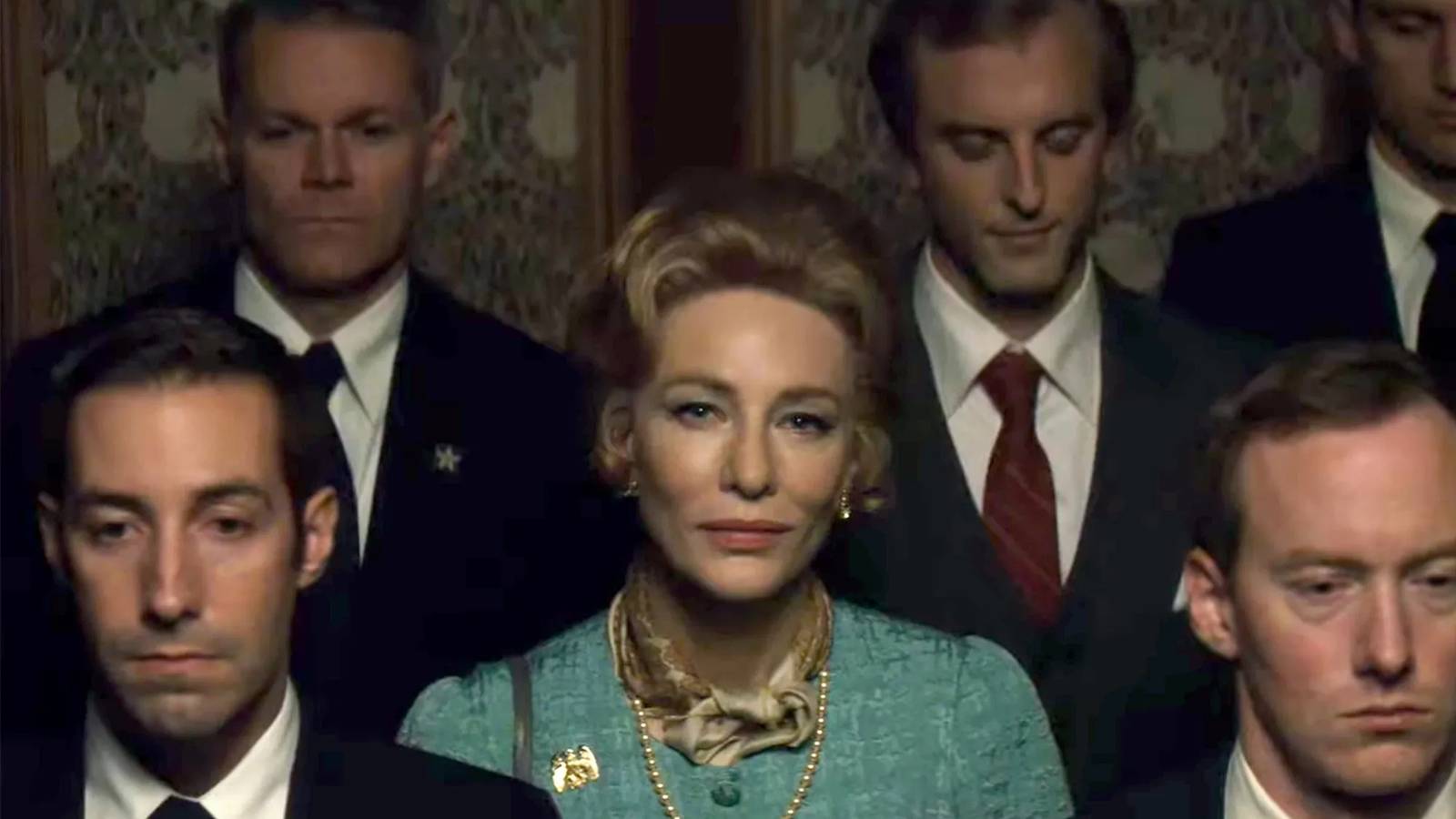
When you hear the words “period drama,” you might be tempted to think of something set in ye olden times, with castles and battles and clothes with lots of ruffles on them. But here in the 2020s, even shows and movies set 20, 30, or 40 years ago qualify as history, even though we can see more clearly how we got from there to here.
Mrs. America is a fantastic period drama set in the United States in the 1970s, chronicling the failed attempt to pass the Equal Rights Amendment (ERA). This nine-episode limited series landed on Hulu in 2020, and no other period drama released this decade has yet surpassed it.
What is Mrs. America about?
History of Feminism 101
Mrs. America has an ensemble cast led by Oscar winner Cate Blanchett, so you know going in that the acting talent is going to be off the charts. She plays Phyllis Schlafly, a conservative activist who rose to prominence in the 1970s by opposing passage of the ERA, a proposed constitutional amendment that would have guaranteed that “[e]quality of rights under the law shall not be denied or abridged by the United States or by any State on account of sex.” In other words, it would have made men and women equal in the eyes of the law.
Your might assume that someone like that is a villain, but while Mrs. America doesn’t portray Schlafly as a saint, it doesn’t take the easy route and paint her as a monster, either. She’s portrayed as a serious activist who ran for Congress multiple times and who experienced first-hand harassment and belittlement at the hands of her male colleagues. Putting together a movement to oppose the ERA gave her the level of influence she always wanted, but it led to ironies. Schlafly opposed the ERA partially on the grounds that it would erode the family unit and devalue the traditional role of women as wives and mothers, but she herself was a fiercely ambitious person with a great many interests outside the home. She emerges as a complicated, contradictory figure, and Blanchett plays her to the hilt.
Mrs. America is full of characters like that. We also meet the women on the other side of the conflict, the ones trying to pass the ERA. They include feminist activist Gloria Steinem (Rose Byrne); politician Shirley Chisholm (Uzo Aduba, star of the fun Netflix show The Residence), the first Black woman elected to Congress and the first woman and the first Black person to ever run for a major party’s presidential nomination; activist Betty Freidan (Tracey Ullman), author of The Feminine Mystique; and more.
Mrs. America portrays the feminist movement with the complexity it deserves
Nuance, 1970s style
The strength of Mrs. America is how detailed and nuanced it gets when digging into this fascinating period of history. The feminist movement of the 1970s was not without its internal conflicts. For instance, in one episode that’s a battle of wills between Chisholm, who wants to create a committee that will tackle sexual harassment among congressmen and their female employees; and activist Bella Abzug (Margo Martindale), the leader of the National Advisory Commission for Women under President Jimmy Carter. Abzug believes in the aims of the committee, but she’s a pragmatist who knows that it might risk fracturing bipartisan relationships needed to get the ERA passed.
How willing should politicians be to compromise their values in order to achieve long-term goals? Is having power worth it if you have to sell out your constituents to get it, even though you wouldn’t be able to help them without it? Politicians deal with these exact questions today. Mrs. America shows us that in some ways, not much has changed.
It’s not really a spoiler to say that, in the end, the ERA does not pass. The feminist movement of the 1970s, which seemed on the cusp of becoming a mainstay in American politics, fizzled out in the 1980s, as political priorities changed and cultural norms shifted. Was it a failure? Did it succeed so thoroughly that a formal movement was no longer needed? Mrs. America doesn’t provide easy answers to those questions, which is to its credit. If it wants to remain honest about its subject, it can’t.
When the people your TV show is about object to it
History, Drama, and the thin line separating the two

One of the quirks of making a show about recent history is that the people who were actually there can weigh in on it. The real-life Gloria Steinem wasn’t a fan, complaining that the show focused too much on conflicts between women on either side of the movement and not enough on the lobbyists protecting powerful financial interests, which she thinks are more responsible for the failure to pass the ERA. Then again, fellow second-wave feminist Brenda Feigen thought the series portrayed the real-life characters very accurately, so there’s still disagreement in the ranks.
Mrs. America is the kind of show that’s going to inspire debate, which is a good thing. After all, a lot of the issues it deals with still haven’t been fully hashed out today, and of course there’s still discussion to be had.

7 Classic Shows I’m Binging on Netflix Right Now (and You Should, Too)
Netflix has a vast collection of older shows looking to capture your attention.
The other kind of period drama
I’ve made Mrs. America sound like a dire watch, but there’s also lots of downtime and moments of levity. It’s a serious show, but not an incredibly intense one.
If you’re looking for the more traditional kind of period drama, the one with the ruffled clothes, feel free to check out stuff like Downton Abbey on Prime Video or The Last Kingdom on Netflix.

- Release Date
-
2020 – 2019
- Network
-
Hulu
- Directors
-
Laure de Clermont-Tonnerre, Amma Asante
- Writers
-
April Shih
-

Cate Blanchett
Phyllis Schlafly
-

Novie Edwards
Willie B. Reed
-

Rose Byrne
Gloria Steinem
-
Cindy Drummond
Lottie Beth Hobbs