






I love CES for the weird and the wacky, and Razer has truly delivered for me. I first saw Razer’s Project AVA at CES 2025, where Razer presented its AI tool as a gaming aid but didn’t seem entirely sure where it was going with it.
How wrong we were.
At CES 2026, Razer presented AVA as a fully-equipped visual AI desk companion that learns about everything you do, rather than just your gaming preferences. AVA is still very much game-integrated, but Razer is adjusting its focus to a more general audience with the idea that you’ll have your “enthusiastic gaming wingman” with you at all times.
Razer reveals its bottled anime girl at CES 2026
Project AVA is stepping into the “real” world
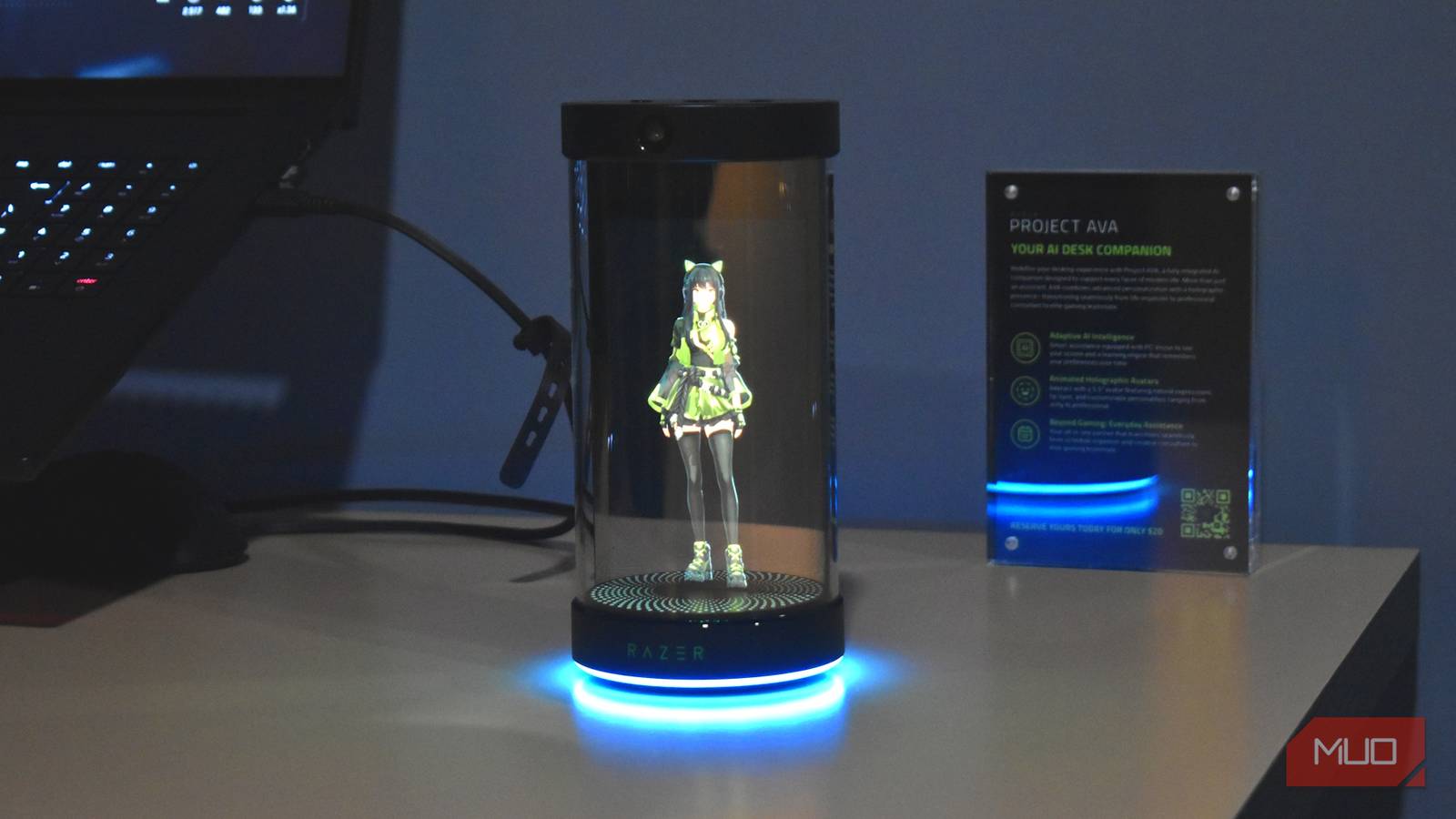
Razer showed us a couple of big changes to AVA at CES 2026. First, AVA is no longer confined to your screen. AVA now lives in a 5.5-inch holographic pod that lives on your desk, sitting alongside you at all times.
It’s still connected to your computer via a USB-C cable, but you can now interact with AVA without speaking to the computer as an intermediary, as the new capsule enclosure includes microphones, speakers, and an HD camera to track its surroundings. Then, inside the enclosure, there is a hologram that you can interact with, such as asking questions about the latest news, directions, or information on local events, and so on.
But AVA hasn’t lost its gaming integrations. You can still ask the AI avatar in the tube to pick or optimize a new loadout for Battlefield 6, while AVA can also make suggestions to your mouse polling rate for games, and so on.
The demo of AVA we saw was running xAI’s Grok to answer questions. It successfully answered specific questions about CES, such as where the Razer booth was on the floor, what was worth seeing at the show, and some of the interesting announcements, and I was struck by how responsive the AI tool was.
You can also choose different AI tools if you prefer something different. Razer has made AVA platform agnostic, so if you prefer ChatGPT’s responses, you can switch over. It gives you the option to choose whatever you want, which is a nice touch; no one wants to be locked to a specific AI tool. There may even be support for custom LLMs down the line, which would add considerably more customization to AVA.
MSI’s new laptops bring its gaming smarts to everyday portables, and they look so good
Shiny, fast, and ultra-portable—what’s not to love?
Pick your AI avatar
Customizable AI avatars are also coming
Part of the fun and weirdness of AVA is that it’s now a visual AI rather than just something on your PC. It manifests in the holographic avatar, which Razer is presenting as a proper AI companion rather than just a tool. It sounds like the company envisages it as an AI tool that will live alongside you, rather than just get involved when you’re gaming.
For example, Razer showed us a video of a chap using AVA around the house, asking for tips and suggestions for cooking and so on. The AVA avatar responds all the time enthusiastically (it’s AI!) and wants to help with all the little tasks.
AVA’s premade avatars include Kira, a female anime-style waifu type character, Zane, a more burly male character that looks like the “Giga Chad” meme, and Faker, a legendary esports player sponsored by Razer. Each brings a specific personality to the table, but some of the speech and mannerisms are the same, and, dare I say, a little on the cringy side. Asking a question will often result in small quips slipped into the conversation, adding some extra flavor, but many of the comments feel very teenager-edge-lord.
I’m probably showing my age a bit, but as a man approaching 40, I don’t want or need the extra little comments. Perhaps there’s a way to turn those bits off, but I wasn’t shown that during the demo.
What I find particularly interesting about AVA is that Razer isn’t positioning this as a gaming product anymore. Sure, it has RGB ,and it’s very clearly a Razer product, but the company is pushing it as a “Friend for Life” that will be alongside you, helping your every decision.
It comes through in the conversation and responses, with Razer crafting AVA’s appearance as a cute anime girl that lives alongside you, giggling and blushing as it responds and generally acting as if there is a real relationship. I can’t decide whether it’s odd that Razer is pushing this cutesy anime girl, or if I’m actually overthinking it and this is just a normal progression of tech. I mean, people talk to ChatGPT and Gemini all the time, so why not have a visual representation of it?

MakeUseOf’s Best of CES 2026: Headphones, rollable laptops, and multi-screen smartphones
It’s a bumper year for shiny new tech at this year’s edition of CES.
I won’t knock it until I’ve really tried it
As with most tech, I’ll reserve my full judgement until after I’ve given it a proper try at home. A quick demo on the CES 2026 show floor is useful, but it doesn’t give you the full experience. And as I’m swaying between potentially super useful and super weird parasocial AI anime girl vibes, it’s best to wait to pass full comment.
You can reserve access to Razer’s Project AVA for $20, though there was no official final price for the AI project, nor a specific date of launch bar some point in 2026 H2. I’d estimate this will come at around $200, similar to other Razer hardware.