


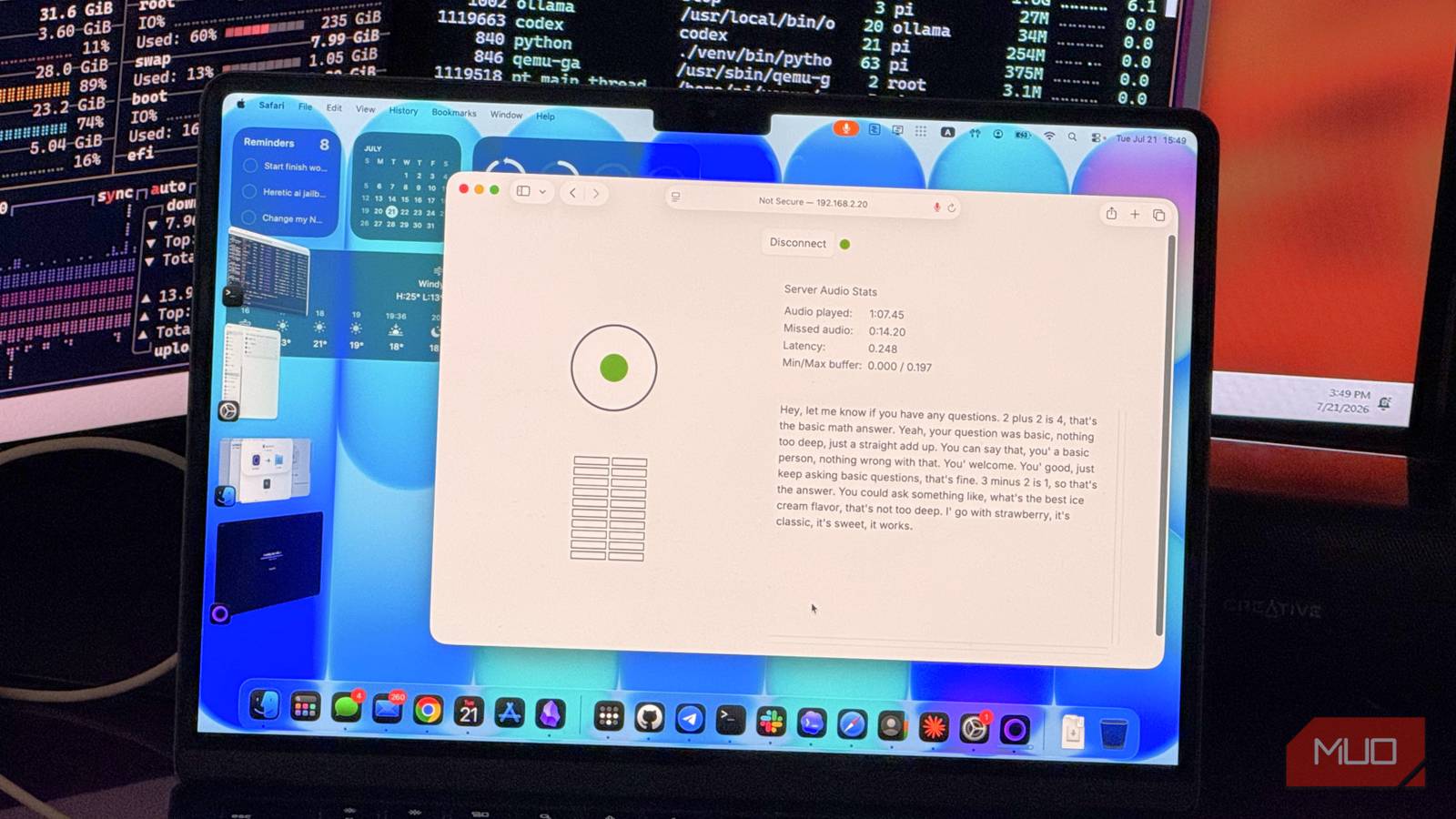
Local LLM models are fantastic because they’re local, and for us normal people with regular hardware, that’s usually where it ends. But, I’ve got a surprise. NVIDIA’s latest voice model doesn’t feel like that. It was astonishing, simply because it was astonishing, regardless of the medium. The fact that it was running locally on my hardware added to the astonishment, it didn’t cause it.
I could describe it, but I think it’s best if you just see for yourself.
PersonaPlex is a full-duplex voice model
NVIDIA has been cooking lately
When I say latest, I mean a bit late. PersonaPlex was released in January 2026 as a 7-billion-paramter, full-duplex speech model. I’ll emphasize the full-duplex part, and the speech model part. This is not a text-to-speech model, or a speech-to-text model, or a text model, or a combination of those. It is a speech model. A model that you can speak to, right out of the box.
Lots of AI assistants offer “live” or “voice” modes, but these are usually toolings that go on top of the core text-only LLM. So, you speak, a model transcribes what you said, sends the text to the LLM, the LLM responds in text, then uses a voice model to turn its response to audio and play it back. That’s not how conversations work. When us humans talk, we don’t write it first and then read it. When someone talks to us, we don’t write it down first, then think about it. No, we simply think in voice.
A full-duplex speech model is the closest approximation to an actual conversation. PersonaPlex continuously processes two audio streams (yours and its own) while also predicting an internal response stream. ChatGPT’s new live mode also works the same way — I’ll talk more on that later.
Underneath, PersonaPlex is based on Moshi, an open full-duplex speech model from Kyutai (co-founded by former Google CEO Eric Schmidt). Moshi uses a neural audio codec called Mimi to compress speech into tokens at 12.5 frames per second. A large temporal transformer then models the conversation, and a smaller depth transformer handles the audio codes inside each frame.
What NVIDIA did was to fine-tune that foundation for controllable roles and voices. You provide a text prompt describing who the model should be, plus a short voice sample. The included demo can become a teacher, a customer-service agent, or Alex, the astronaut.
Getting it running was surprisingly ordinary
Pull, venv, and run

There is some setup, of course, but we live in the golden age of one-line setup commands. You need the repository, PyTorch, the Opus audio library, access to the weights on Hugging Face, and a browser with microphone permission. Then the server downloads the model and exposes a local web interface. NVIDIA provides the commands in the GitHub repository.
On first run, the app will download the model, which is ~9GB in size. Once that’s done, it’ll warm up, and give you a web address to access it.
Open the page, choose a voice, write a persona, and start talking. There is no API account and no per-minute bill. Once the weights are downloaded, the conversation stays on your machine.
Browsers only allow microphone access from a secure context, which usually means the page must use HTTPS. PersonaPlex’s startup command therefore generates a temporary self-signed SSL certificate for the web interface. Your browser will warn you that the certificate is not trusted, but you can proceed as long as you are connecting to your own PersonaPlex server. If you already have a properly configured SSL certificate, you can skip this temporary certificate step.
On my RTX 3090, the standard BF16 implementation uses around 19GB of VRAM and runs very smoothly, in real time. 19GB is substantial, but it is hardly supercomputer territory. A used 3090 can run an end-to-end conversational speech model that would have looked like a research demo from the future not long ago.
But, I did say that you can run it on 8GB, didn’t I? Well, the official PyTorch implementation still expects a large GPU. But, community projects have already added 8-bit and 4-bit quantization, with 8–16GB support. reported by projects such as the PersonaPlex ComfyUI integration. There’s also moshi.cpp which reports great performance with even an 8GB RTX 2070 Laptop. So yes, PersonaPlex can run on an 8GB card on a laptop — but not through NVIDIA’s untouched reference path, and performance will depend on the quantization, backend, and how much work spills onto the CPU.
PersonaPlex has an interesting limit
Four minutes from Alex to Kim
PersonaPlex is astonishing in the moment. It’s less convincing after a long conversation, but still astonishing, because even the failure is interesting.
The model has a rolling memory of 3,000 frames. Mimi advances at 12.5 frames per second, so the arithmetic is wonderfully simple:
3,000 frames ÷ 12.5 frames per second = 240 seconds
That’s four minutes. The persona prompt, voice conditioning, incoming audio, and generated conversation all pass through this finite window. Once it fills, new frames overwrite the oldest ones. PersonaPlex doesn’t crash when its memory is full, but it begins forgetting how the conversation started.
I watched this happen in a particularly entertaining test. The model began as Alex, the astronaut from the Mars scenario. We eventually wandered into a long conversation about money and cars. After enough time had passed, I noticed that Alex keeps repeating some words in her responses. I asked Alex for her name, and Alex suddenly declared, “My name is Kim. I’m actually a very good friend of yours.”
This wasn’t intended. Alex had fallen out of the model’s memory. It was only mentioned in the early frames of the conversation and never mentioned again, so the model forgot that its name is Alex. When asked again, it came up with a new name, and a whole new identity.
The deterioration accelerated from there. “That’s very good” became “Very, very good for you.” Then it repeatedly asked whether I had more questions. Finally, it became trapped, saying “What’s going to happen?” again and again.
Each repetition entered the newest part of the context, making another repetition more likely, while the useful conversation continued disappearing from the other end. The current server doesn’t apply an effective repetition penalty, so there is little to pull the model out once it falls into that hole.
I managed to recreate this and catch it on video. I’ve attached it to the beginning of the article — skip past to the fourth minute to see.
Increasing the context is possible. The 3,000-frame attention cache costs roughly 1.46GB of VRAM and grows linearly, so an eight-minute cache would be plausible on a 24GB card. But… that only postpones the problem. And although you can increase the attention cache, it was intended to be used at the default 3,000 frames. Inference might suffer in larger caches, despite your hardware.
GPT‑Live is the obvious comparison
Full-duplex and running on a massive cloud data center

OpenAI’s new GPT‑Live has the same headline advantage. It listens while it speaks, reacts to interruptions, fills natural gaps, and can decide whether to keep talking or stay quiet many times per second.
But comparing PersonaPlex to GPT-Live is only valid in the speech area, not beyond that. GPT‑Live is part of a much larger system. It supports longer conversations, web search, memory, and tools. When a request needs proper reasoning, it can delegate the work to a frontier model like GPT‑5.5 in the background, then bring the result back into the live conversation.
PersonaPlex has nobody to ask for help. It can’t search the web, call a tool, hand a difficult question to a stronger model, or reliably remember a long conversation (4 minutes, in our case). The same 7-billion-parameter model has to listen, reason, maintain the persona, and generate speech by itself.
In return, PersonaPlex is seriously fast. In my experience, it was way faster than GPT‑Live despite running locally. Of course, that doesn’t make it smarter or more useful. It makes it a remarkably good demonstration of how much responsiveness can be squeezed out of a self-contained model.
PersonaPlex is a brilliant showcase
PersonaPlex is not a finished product. It’s a showcase. It forgets, drifts, invents details, and in long conversations, eventually talks itself into loops. The custom voices are approximate, and the official implementation still wants an expensive GPU.
But, if you can, run it and talk to it for two minutes. Watch a locally running model listen, speak, and hesitate — all happening really fast.
That aside, PersonaPlex is fully open-source. NVIDIA has shown the community how this kind of full-duplex voice model works, then released the code and weights for developers to modify and build into other workflows. PersonaPlex itself isn’t a finished product, but it will be the foundation for many of them. And who knows — maybe systems like GPT-Live drew some inspiration from the same ideas.