


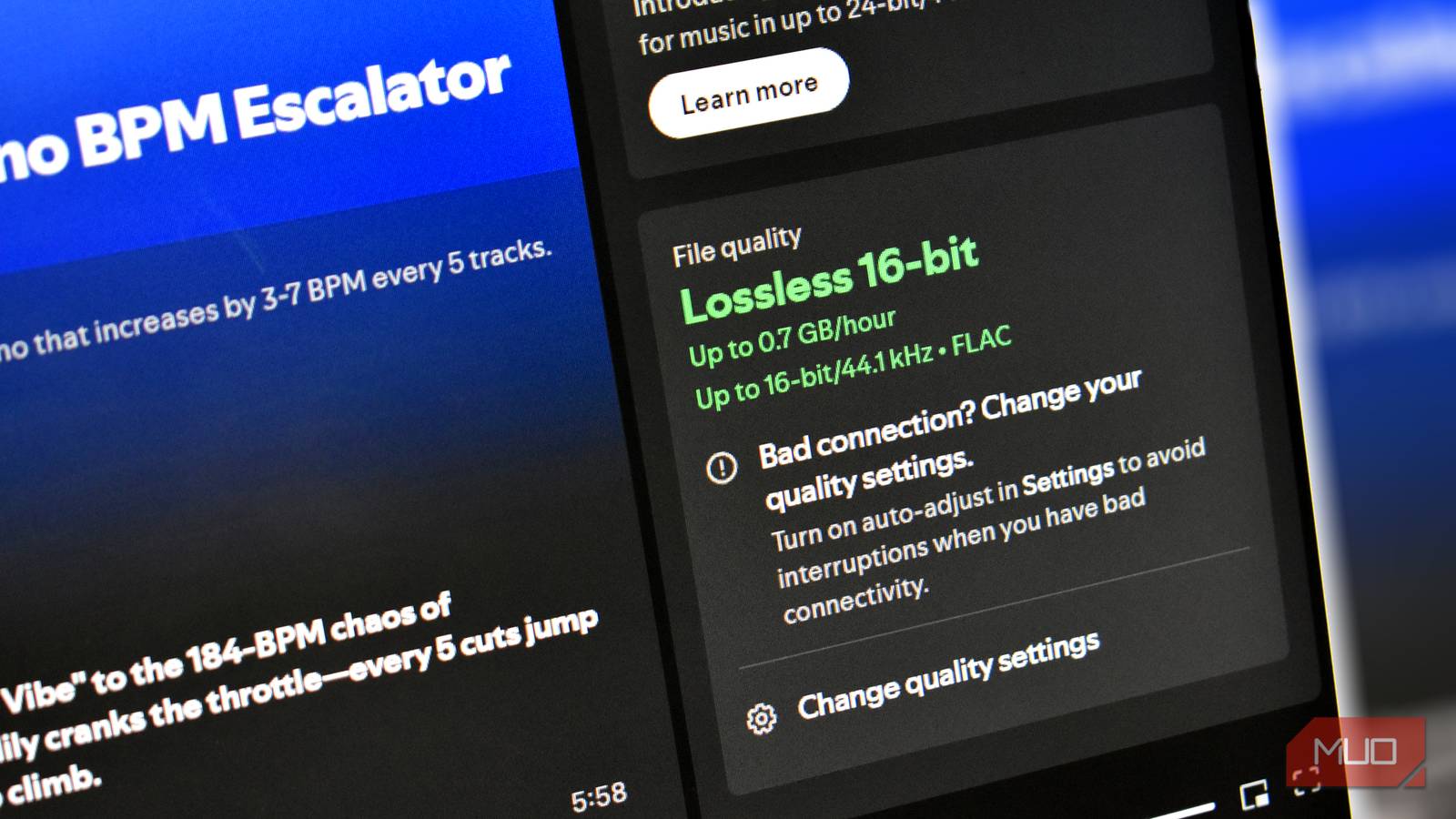
Spotify Lossless finally arrived in September 2025. Though Spotify kept us waiting for lossless audio for eight years, the promise of much higher quality audio on our favorite streaming platform kept us going through the bad times, pressure to switch streaming services, and all of Spotify’s weird decisions.
However, even though Spotify Lossless is now available worldwide, it’s unlikely you’re actually hearing anything different. Not because lossless is a gimmick, but because most listening setups physically can’t take advantage of it. If you’re using Bluetooth headphones, wireless speakers, or even certain “premium” wireless headsets, your audio is being compressed again before it reaches your ears. Which means you could be paying extra for a benefit your hardware simply cannot deliver.
What “lossless” actually means
It’s just really, really good audio quality
Basically, when it comes to digital audio, you have two main file types: those that keep all of the audio data (lossless) and those that discard some audio data for the sake of file size (lossy). It’s similar to how a JPEG image compresses data to serve a very similar outcome, but loses some quality in the process.
Spotify’s previous top audio quality level (Very High) was 320kbps using Ogg Vorbis, a well-known lossy audio format. It was decent but still nothing near the level required for lossless audio, which is typically considered to start at CD quality (16-bit / 44.1kHz—around 1,400kbps), and requires file formats like FLAC or ALAC.
But, of course, you can’t listen to numbers on a screen; the proof is in the output. And with the right audio hardware, you can hear a real difference between lossy and lossless audio. But that’s the crux of the biscuit: many folks don’t have capable audio hardware, which makes experiencing lossless near impossible.
Your wireless headphones probably break lossless audio
It’s a common Bluetooth codec-based problem

I love Bluetooth headphones and earbuds. I use them all the time, often travelling with both plus a wired set for backup (plus a trust 3.5mm to USB-C converter—even if some folks are glad to see the back of 3.5mm, it’s still really useful!).
But the problem with Bluetooth is that it’s all about compression and effective data delivery, supported by its vast array of audio codecs. Most Bluetooth codecs focus on stability rather than quality, using lower bitrates to ensure a continuous connection, but they compromise your listening experience in the process.
Now, there is absolutely a time and a place to use these Bluetooth audio codecs; some even think they’re better than lossless! But when it comes to Spotify Lossless (and any type of lossless audio), Bluetooth is basically making it null and void.
|
Bluetooth Audio Codec Comparison |
|||||
|---|---|---|---|---|---|
|
Codec |
Where you’ll see it |
Max bitrate (approx) |
Is it lossless? |
Real-world quality |
Key limitations |
|
SBC |
Default on all Bluetooth devices |
~328 kbps |
❌ No |
Often muddy, lacks detail |
Low efficiency, widely considered the weakest codec |
|
AAC |
iPhones, AirPods, many mainstream headphones |
~256 kbps |
❌ No |
Cleaner than SBC, still compressed |
Optimised for Apple devices, variable quality elsewhere |
|
aptX |
Many Android phones + headphones |
~352 kbps |
❌ No |
Comparable to AAC |
Still lossy, aging codec |
|
aptX HD |
Some higher-end Android devices |
~576 kbps |
❌ No |
Better dynamics, more detail |
Still compression, limited device support |
|
aptX Adaptive |
Newer Qualcomm devices |
~279–420 kbps (dynamic) |
❌ No |
Can sound very good |
Prioritises stability/latency over fidelity |
|
aptX Lossless |
Very limited hardware |
Up to ~1,200 kbps |
⚠️ Technically yes |
Highly accurate with right devices |
Only works with Snapdragon Sound devices; rare support |
|
LDAC |
Sony headphones, many Android phones |
Up to 990 kbps |
⚠️ Almost |
Often excellent in ideal conditions |
Drops bitrate in real-world use; unstable in busy RF environments |
|
LHDC |
Some Xiaomi, Oppo, Huawei devices |
Up to ~900 kbps |
⚠️ Almost |
Similar to LDAC |
Limited ecosystem; inconsistent support |
|
LC3 |
Bluetooth LE Audio (newer devices) |
~160–345 kbps (efficient) |
❌ No |
Surprisingly good for low bitrates |
Designed for efficiency and battery life, not hi-fi |
As you can see, mathematically, there is actually only one codec capable of delivering “true” lossless audio, and even then, it only works with certain devices. The world of Bluetooth headphones and earbuds and lossless audio is fiction, even if you see the “hi-res audio” label on the box.
Bluetooth isn’t the only connection option
How does Bluetooth stack up against 2.4GHz audio?

Of course, Bluetooth is far from the only option. 2.4GHz wireless audio is also available, though the latter typically requires a proprietary dongle sent with your headphones or earbuds.
2.4GHz wireless audio is murkier. It’s not standardized in the same way as Bluetooth, and most manufacturers use proprietary implementations that don’t reveal any real specs. But plenty claim that their 2.4GHz wireless can deliver full lossless audio. For example, the wonderful Audeze Maxwell gaming headset claims to deliver 24-bit/96 kHz over 2.4GHz. Having tried these headphones and other Audeze headphones such as the LCD-1, I’d believe Audeze. (Seriously, unreal headphones!)
ASUS makes similar strong claims about its ROG Cetra True Wireless SpeedNova earbuds, which I’ve not tried but heard good things about, SteelSeries’ Arctis Nova Elite, the “world’s first hi-res certified wireless gaming headset.”
The takeaway from this is that, yes, 2.4GHz wireless audio is capable of Spotify Lossless, but your mileage may vary depending on the hardware you’re using.
Want guaranteed perfection with Spotify Lossless?
It’s time to find your trusty wired cans
Wired is wired. You’re always getting the full audio experience, and there is a reason why everyone says wired is best. The data travels from A-to-B through a cable, straight from the source to your headphones, which means you’ll very much enjoy Spotify Lossless.
But even then, it’s not always certain due to cheap headphone jacks, poor quality DACs and USB-C dongles, and poor quality headphones that couldn’t deliver the detail of Spotify Lossless if they tried. Indeed, you may even find that a cheaper $75 pair of wired headphones performs better than a more expensive set of wireless cans simply because they’re not fighting against the compression present in Bluetooth codecs.
If you’re considering lossless audio on a smartphone, it’s basically pointless unless you have a USB-C DAC, which is a great investment for anyone who wants some extra audio quality.

I’m an audiophile, and this open-source player blows every other app away
Google should’ve shipped this instead of YouTube Music.
Don’t give up on Spotify Lossless even if you don’t have the gear
Even if you don’t have the “right” audio equipment, there are still some marginal benefits to streaming Spotify Lossless. For example, some lossless tracks have better mastering or have been reworked, and it comes from a higher-quality source file, so you’ll still see some improvement.
Then there is the age-old problem of double-compression, where your already compressed audio file is compressed again for Bluetooth transmission. Like a JPEG file, Bluetooth codecs remove audio they think you won’t notice, but when it’s put back in there, you hear your favorite songs differently.
But for the real Spotify Lossless experience, you’re definitely going to want to upgrade your audio hardware and let yourself fall in love with your favorite music all over again.