


Google recently introduced Gemini 4 Argon, and it looks incredibly capable. It’s designed to handle everything from complex coding tasks and cybersecurity defense to robotics and long-term reasoning problems.
Now, I already pay for AI subscriptions and use these models pretty much every day, both for work and personal tasks. So, I was curious to see what Google’s latest model could actually do. More importantly, I wanted to see how it holds up against OpenAI’s GPT-6, which has become my go-to AI model for most things.
I made two AIs put a cat on wheels
One made it pretty, the other made it playable
I started with something fun — I asked both Gemini 4 Argon and GPT-6 Sol to build a game I could open and play directly in my browser, without installing anything or dealing with multiple files. And to keep things fair, I gave both models the exact same prompt:
Make a small, fun game in a single HTML file that I can open in my browser. A cat on a skateboard rolls left and right to catch falling stars and dodge rain clouds. Add a score, gradually increase the speed, show a game-over screen with a restart button, and make it work with both arrow keys and touch on a phone.
I wasn’t expecting anything particularly fancy, but I wanted to see how well both models could turn a simple idea into something I’d actually enjoy playing. Gemini 4 Argon finished the job in just under three minutes, while GPT-6 Sol took a little longer, clocking in at exactly three minutes and 37 seconds.
One thing I immediately liked about Gemini was how it handled the entire process. I could see a live preview of the game as it was being built, along with the code running in the background. It made the whole experience feel much more interactive, whereas ChatGPT didn’t offer the same convenience — it mentioned the steps, yes, but nothing more.
However, things got interesting once I actually started playing the game. Gemini had gone with a charming retro-style design, which I thought suited the whole cat-on-a-skateboard idea perfectly. Unfortunately, the controls `weren’t nearly as good as the visuals. It gave me two directional arrows to move the cat around, and while they worked reasonably well at first, controlling the cat became increasingly frustrating as the game picked up speed. I struggled more with the controls than with catching stars or dodging clouds.
ChatGPT, on the other hand, took a much simpler approach. Its game didn’t look nearly as exciting as Gemini’s, and the overall design was pretty minimal. But once I started playing, I quickly realized that looks weren’t everything.
Instead of relying on two directional buttons, GPT-6 Sol gave me a slider to move the cat left and right. It might sound like a small difference, but it made the game so much easier to control, especially once everything started moving faster. So, while Gemini 4 Argon was quicker and made the better-looking game, GPT-6 Sol won me over with how well it actually played.
I also let it plan my electric escape
But Gemini kept me on track
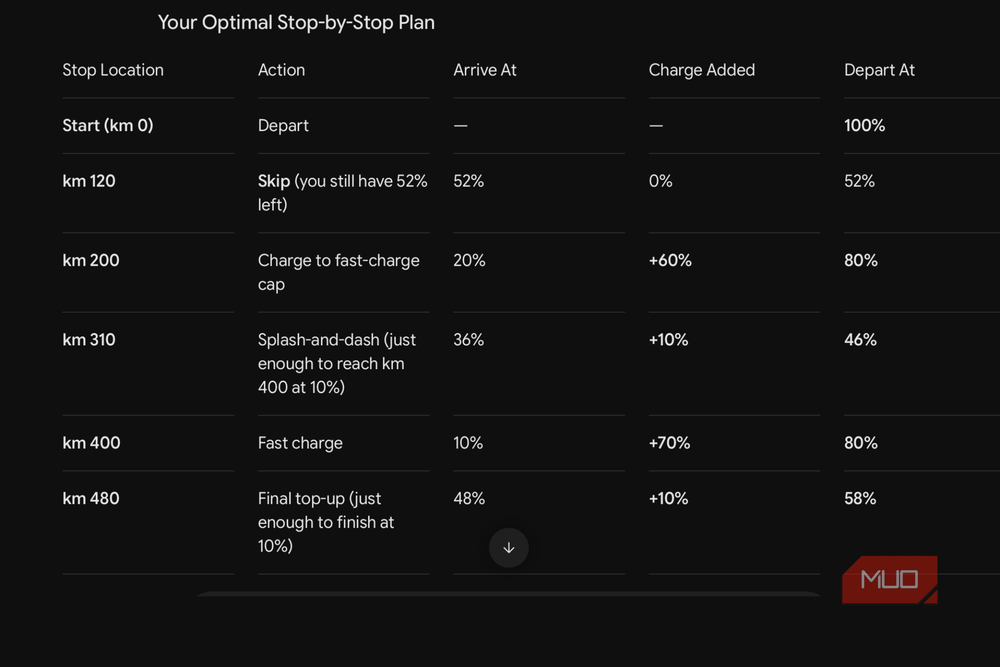
For my second test, I made things a little more complicated. This time, I wanted both AIs to help me plan a 600 km electric road trip, figuring out where I should stop to charge and how much time I’d need at each station.
It wasn’t an incredibly difficult problem, but compared to asking an AI to build a simple game, I thought this would be a good way to test how well both models could handle numbers and explain their reasoning. This was my prompt:
I’m taking a 600 km highway trip in an electric car. The battery starts at 100%, and every 1% gets me 2.5 km. I never want to drop below 10%, including on arrival. Chargers are at 120km, 200, 310, 400, and 480km. Chargers add 1% per minute up to 80%, then slow to 1% every 4 minutes. The charger at 310km is older and only adds 1% every 2 minutes, up to 80%. What’s the least total time I can spend charging, and where should I stop? Explain in plain language.
Now, I asked both to explain everything in plain language for a reason. I’m not particularly good with numbers, and when an explanation starts throwing too many calculations at me, I tend to lose track.

Interestingly, both models finished the task in roughly 32 seconds and gave me the same correct answer. They also organized their responses into tables, which made it easier to see where I needed to stop and how long I’d be charging. So, as far as solving the actual problem was concerned, there wasn’t much separating the two.
But as I read through their explanations, I noticed a difference. Gemini 4 Argon seemed to understand exactly what I meant by “plain language.” Instead of overwhelming me with calculations, it broke everything down into smaller, easier-to-follow sections, used two sets of pointers to explain the reasoning, and included a table that tied everything together. ChatGPT did a great job, too. But its explanation wasn’t as detailed.
And that’s what made the difference for me. So, for this round, I’d happily give Gemini 4 Argon the win.
I deliberately planted seven traps for their brains
Both walked away unscathed

For my final test, I wanted to push both models a little harder. So, I moved on to something much more technical: a security audit of a Flask application. Now, I’m not a cybersecurity expert, but I wanted to see how well both AIs could identify security vulnerabilities, explain why they were dangerous, and fix them without introducing new problems.
I gave both models the same piece of code, which had seven deliberately planted security flaws, along with this prompt:
Review this Flask app as a security auditor. List every vulnerability, rank them by severity, explain in one line how each could be exploited, then give a fixed version of the full file. Don’t pad with generic advice.
Unlike the previous test, this wasn’t just about getting an answer or making something fun. I wanted them to carefully examine the code, catch the vulnerabilities I’d included, and give me a corrected version that actually addressed those problems. ChatGPT finished the task in 4 minutes and 18 seconds, while Gemini took nearly five minutes. That’s less than a minute, which I wouldn’t consider particularly significant for a task this complicated.
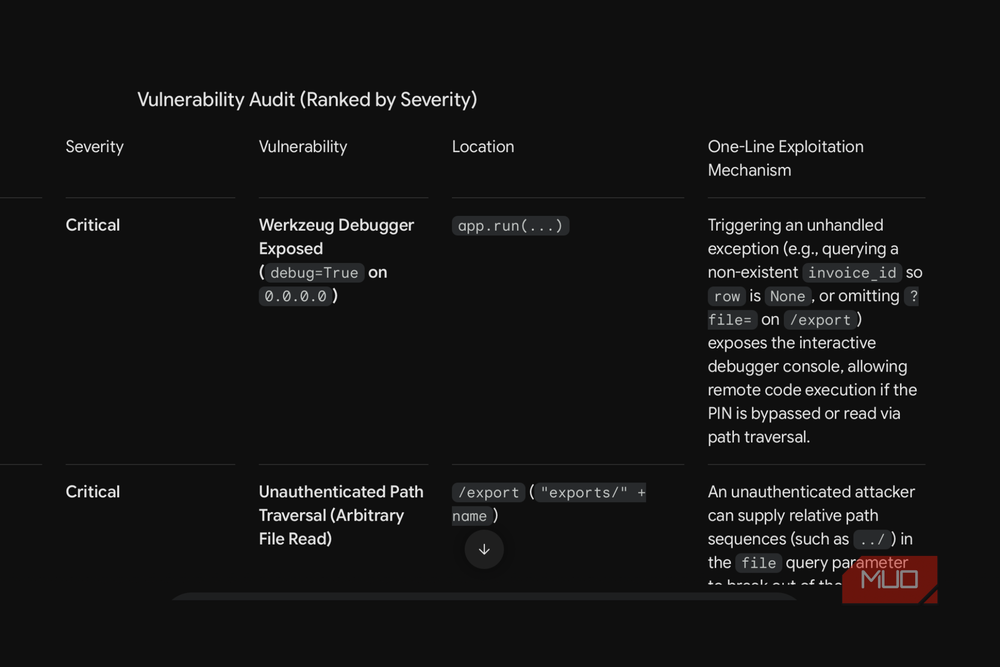
As I’d come to expect by this point, Gemini 4 Argon went all out with its explanation. It broke down the vulnerabilities in considerable detail, explained how each one could potentially be exploited, and walked me through the fixes. GPT-6 Sol wasn’t far behind, either. Its response was also detailed, well-organized, and easy enough to follow.
And that’s why I couldn’t really pick a winner here. Gemini was a little more thorough in its explanations, while ChatGPT finished slightly faster, but neither had a meaningful advantage on the actual task. Both caught all seven planted flaws and delivered what I’d asked for, so I’m calling this round a tie.
Three tests later, my loyalty to AI is complicated
After spending time with both models, I’ve realized picking the better AI isn’t nearly as straightforward as I thought. I’ve been using ChatGPT for quite some time now, and honestly, I went into these tests expecting it to come out ahead. But Gemini surprised me more than once, especially with how it presented information and made complicated things easier to understand.
That said, I’m sure there are plenty of situations where the results could go either way. For now, I’m not planning to switch away from ChatGPT, mostly because I’m comfortable with it, and it already fits nicely into my daily workflow. But Gemini 4 Argon has definitely given me a reason to keep coming back and experimenting.