


When it comes to realistic sci-fi series, The Expanse books by James S. A. Corey are often held up as the gold standard. The Expanse keeps in mind things like the amount of time it takes for messages to travel through the vacuum of space, how artificial gravity is created, and how the Coriolis Effect works.
So far as book series that have been adapted for the screen, The Expanse is definitely among the most realistic, but in terms of book series in general, it has a lot of competition.
Mars trilogy by Kim Stanley Robinson
The Multi-Colored Planet
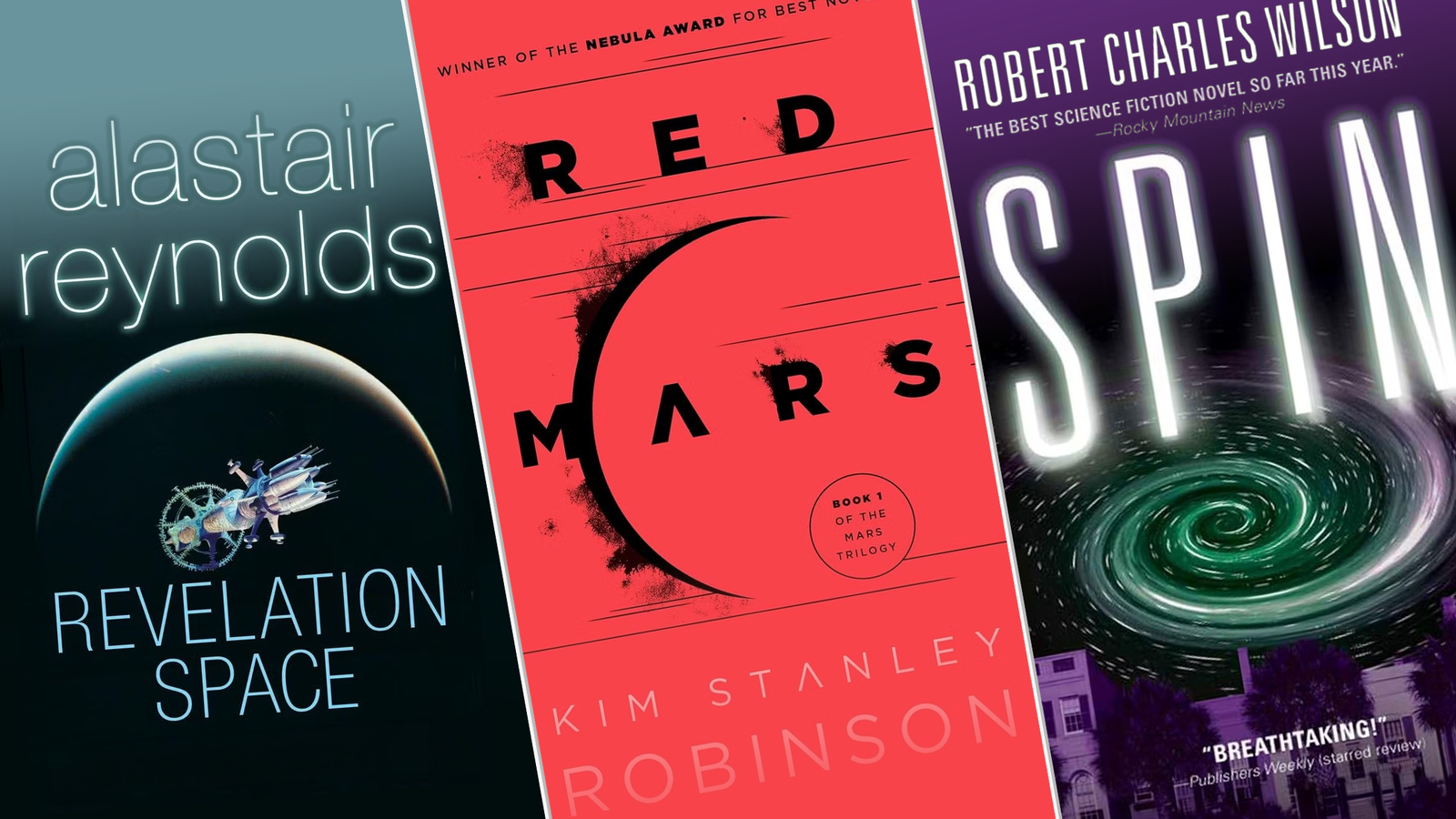
The Mars trilogy consists of three books: Red Mars (1992), Green Mars (1993), and Blue Mars (1996). Taking place over a period of almost 200 years, it covers the attempt to colonize and then to terraform Mars, which becomes a more pressing venture as climate change makes Earth increasingly unlivable.
There’s plenty of intrigue and human drama in the Mars trilogy, as various factions fight each other over how to live on the Red Planet. Some people want to aggressively terraform Mars to make it more like Earth, while others want to preserve Mars the way it is. Multinational corporations try to exert control over the planet’s resources, while climate refuges from Earth migrate there in growing numbers.
Underpinning everything is Kim Stanley Robinson’s commitment to real-world geology, physics, and sociology. Robinson cares about the details, and the Mars trilogy is regarded as one of the best hard science fiction series ever written. Hopefully, someone will eventually have the vision and will to adapt it for the screen.
The Spin Trilogy by Robert Charles Wilson
It’s about time (that you read this)

Spin (2011) has a dizzyingly interesting premise: one night, three childhood friends are looking up at the sky when all the stars disappear. Eventually, it becomes clear that the Earth has been encased in a “spin membrane.” Outside the membrane, time passes normally. But on Earth, time passes much, much faster, with 100 million years passing in the wider universe for every year that goes by on Earth.
This means that life on Earth will end within a few decades, since the sun will grow enormous and eventually explode in the lifetimes of the characters. The three friends grow up and deal with this impending doom in their own ways. The story remains very character-driven, but Robert Charles Wilson discovers all kinds of interesting ways to play with his premise. For instance, what happens when Earthlings colonize Mars, while lies outside the spin membrane? Who or what put it there in the first place?
These and other questions are teased out over the course of this very compelling novel, as well as the sequel books Axis and Vortex.
The Revelation Space Series by Alastair Reynolds
Dune meets Star Wars meets The Expanse

The Revelation Space series is set in a future where humanity has expanded far beyond Earth, and has made both enemies and allies of a variety of extraterrestrial races. The first book in the series, Revelation Space (2000), just scratches the surface. There are eight books in all, plus a great many novellas and short stories.
The Revelation Space series is a proper space opera, with lots of interstellar conflicts and post-human entities and threats to all life in the universe. That said, while a series like Star Wars has little to no interest in plausible science, Alastair Reynolds likes to keep things realistic. For instance, while his books are full of highly advanced technology, faster-than-light travel is largely absent. Also, the books eschew visions of the future that are overly utopian or dystopian; in this series, the future has all the conflicts of the present, just in space.
The Delta-v Series by Daniel Suarez
Another space-obsessed billionaire

Delta-v (2019) is about a billionaire who decides to cut through bureaucratic red tape and mount his own asteroid mining mission. Whether it goes well, you’ll have to read to find out, but the book received a lot of praise for keeping things grounded. The orbital mechanics discussed in the book are plausible; the novel explores how an economy built around deep-space mining would work; and the actual asteroid at the center of the story, Ryugu, is real.
Delta-v is the first book in a planned trilogy. Critical Mass came out in 2023, and there’s one more book to come.
Remembrance of Earth’s Past by Cixin Liu
It’s a good 3-body problem to have

Remembrance of Earth’s Past is one of the more famous sci-fi series on this list, and is currently being adapted by Netflix as 3 Body Problem. In summary, it’s about the people of Earth preparing for an extraterrestrial invasion. We know it’s coming, but because outer space is a big place, it’s going to take the aliens hundreds of years to get here, so we have time to get our ducks in a row.
These books are full of interesting takes on actual scientific problems. The three-body problem is a real physics problem that describes the chaotic way celestial bodies can interact with each other. The books present a chilling solution to the Fermi paradox, which is the contradiction that we’ve never found evidence of alien life despite there being a high statistical likelihood that it exists. At one point, the books use an ultra-strong carbon nanotube material called “Flying Blade” in a plot twist that has to be read to be believed.
The Netflix series is ramping up to an end, so now is a great time to start watching the show, start reading the books, or both.
The works of Andy Weir
Project Hail Mary, The Martian, and Artemis

Andy Weir has only written a few novels, but two out of three of them have become huge hits, and a third adaptation is on the way. The Martian (2015) follows a botanist who’s stranded on the Red Planet, and who turns to his scientific know-how to keep himself alive. Project Hail Mary (2026) is about an unwitting astronaut who makes contact with an extraterrestrial species; the two work together to save their planets from a shared ecological disaster.
Artemis is set on the first city on the Moon. It isn’t as well known as The Martian or Project Hail Mary, but that may change when it also becomes a feature film. All of Weir’s books are praised for being grounded in real, researched science and engineering.
Further reading
These are just some of the great sci-fi novel series out there to read. Whether realistic or far-fetched, all of these can spark the imagination and keep you transfixed for weeks on end.