


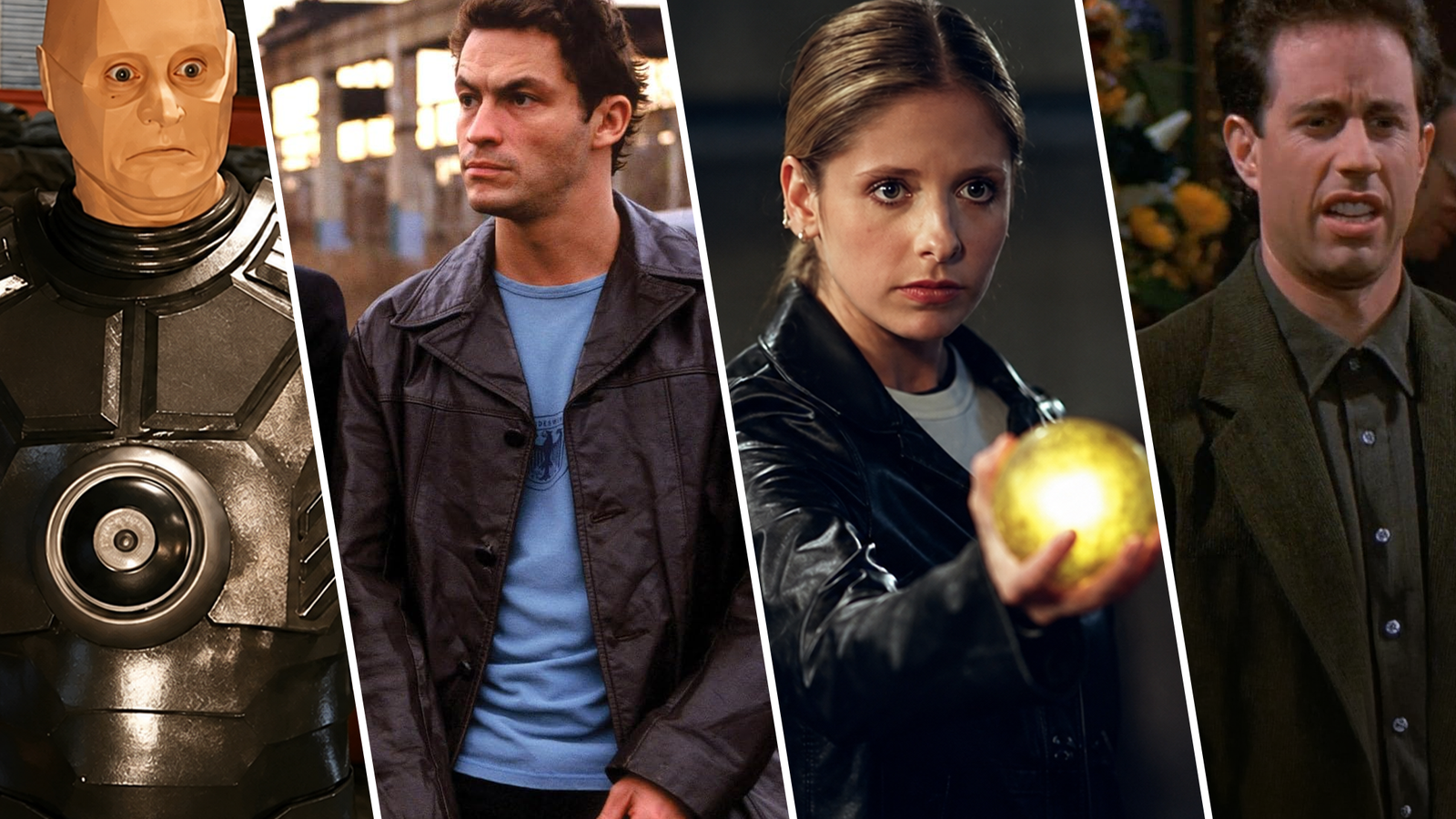
The experience of watching TV has changed a lot in the past few decades. Streaming services have effectively replaced normal TV for a lot of people. For many, commercials became a thing of the past (and then started to come back as those services introduced ad tiers). Bulky traditional television sets were replaced by flat smart TVs.
In that time, studios have tried to repackage older TV shows using modern technology, and while the stated goal is to improve the viewing experience, sometimes it actually makes things worse. Some shows are far better to watch in their original formats than in high-tech “remasters.”
Seinfeld
What’s the deal with making it so we can’t see the visual jokes?
There’s a whole subcategory of remasters that are awful specifically because they change the original aspect ratio of the show. For instance, the classic sitcom Seinfeld was originally shot in a 4:3 aspect ratio, which was common for TV shows at the time. But when the show landed on Netflix, episodes were streamed in widescreen format, so the frame looks less like a square and more like a rectangle.
The problem is that the bottom and top of the original frame are cut off to achieve this new shape, which means you can lose visual information. Above, you can see a pair of shots from the Season 8 episode “The Pothole,” where George drops his keys into a pothole that then gets paved over. In the original version, George gestures angrily at the pothole. In the Netflix version, he gestures at something we can’t see, because Netflix has cut it off. The visual joke is gone, which is a big problem for a comedy.
There are multiple examples of that throughout the show. Since Netflix spent so much money to stream Seinfeld, you’d think they’d at least want to present it to viewers in an intelligible way.
- Release Date
-
1989 – 1998
- Network
-
NBC
- Showrunner
-
Larry David
-

Jerry Seinfeld
Jerry Seinfeld
-

Jason Alexander
George Costanza
-

Michael Richards
Cosmo Kramer
-

Julia Louis-Dreyfus
Elaine Benes
The Wire
One of the best HBO shows, now a little worse

The Wire is definitely one of the best shows ever produced by HBO, which is high praise. A 2014 HD remaster shifted the aspect ratio from 4:3 to 16:9, which caused a bunch of problems.
First of all, there were now some shots where crew members who were standing just out of frame could now be seen, breaking the immersion. The HD visuals meant that some objects that were never meant to be seen in the original resolution now could be.
Most importantly, taking a show that was originally shot in one aspect ratio and forcing it into another one is just going to feel weird, because the original shots were not composed to work in that new aspect ratio. Characters that were supposed to be in the center of the frame are now off to the side, or vice versa. Visually, the remaster made The Wire a more confusing, off-putting show to watch.

- Release Date
-
2002 – 2008-00-00
- Network
-
HBO
- Showrunner
-
David Simon
-

Dominic West
Jimmy McNulty
-

Lance Reddick
Cedric Daniels
-

-

Wendell Pierce
Bunk Moreland
Buffy the Vampire Slayer
In the new version, vampires can walk in the daytime

Here’s one last classic TV show ruined by a shift from the 4:3 aspect ratio to 16:9. Buffy the Vampire Slayer premiered in 1997 and was shot in the squat aspect ratio normal for TV series at the time. In the 2010s, the TV network Pivot aired “remastered” versions of the episodes in widescreen format. As with The Wire, sometimes this produced shots where crew members could now be seen on the sides of the frame.
The remaster also removed some of the filters that made it look like the characters were out and about at night, even though the scenes were sometimes shot during the day. So now vampires, who are famously skittish about daylight, look like they’re moving around in the sun.
Creator Joss Whedon personally bemoaned changes like this. “Adding space to the sides simply for the sake of trying to look more cinematic would betray the very exact mise-en-scene I was trying to create. I am a purist, and this is the purest way to watch Buffy,” he said, per Daily Dot. “I have resisted the effort to letterbox Buffy from the start and always will, because that is not the show we shot.” But even the word of the guy who made the show isn’t good enough to stop some people from trying to “improve” it.

- Release Date
-
1997 – 2003
- Network
-
The WB
- Showrunner
-
Joss Whedon
-

Sarah Michelle Gellar
Buffy Summers
-

Nicholas Brendon
Alexander Harris
-

Alyson Hannigan
Willow Rosenberg
-
Anthony Stewart Head
Rupert Giles
Roseanne
AI upscaling offers exciting new ways to ruin TV shows

Here’s another streaming-era disaster. The ’80s-era sitcom Roseanne streams on Peacock, and in 2025, fans noticed some weird things about it. For instance, at one point in the series, Roseanne runs a diner. There are menus and plentiful text on the walls, but it all looked like gibberish.
Meanwhile, over on Netflix, The Cosby Show spin-off A Different World was looking very strange. Characters’ eyes seemed to float around in their sockets, and faces could look strange and deformed. These shows were upscaled using AI, and clearly whoever oversaw the process did not pay much attention to detail.
AI tools can be very useful, but you can’t just run hundreds of episodes of TV through an upscaler and trust that everything is going to be fine. Roseanne and A Different World are examples of what happens when production companies want to remaster a show but don’t have the time or the will to do a good job.

- Release Date
-
1988 – 2018-00-00
- Network
-
ABC
- Showrunner
-
Bruce Helford
- Directors
-
Andrew D. Weyman, Gail Mancuso, John Pasquin, John Whitesell, Philip Charles MacKenzie
- Writers
-
Amy Sherman-Palladino, Danny Jacobson, Eric Gilliland, Joel Madison, Maxine Lapiduss, Don Foster, Jennifer Heath, Joss Whedon, Norma Safford Vela, Grace McKeaney, Bob Nickman, Michael Borkow, Pat Bullard, Tom Arnold, Denise Moss, Sy Dukane, Daniel Palladino, Garland Testa, Janet Leahy, Nancy Steen, Norm Macdonald, Richard Whitley, Stan Zimmerman, Allan Katz

Red Dwarf
A classic botched remaster

This is a failed attempt at a remaster from long before the current era of AI upscaling. Red Dwarf is a classic British sitcom about a man (Craig Charles) who wakes up on a spaceship after millions of years to find that he is the only human left alive, a rare sci-fi comedy. The show began airing in 1988 and became a cult hit. In 1997, there was an attempt to remaster the first three seasons in the hopes that they could be sold to international audiences, and fans were not happy with the results.
Dialog was omitted from some of the episodes, including some classic jokes fans were attached to. The entire show was given a filmic look, which was at odds with the small-scale charm of these early seasons. And some of the physical models used for the spaceships were replaced with early computer-generated effects, which didn’t look nearly as good. That’s one of the original physical models above and the CGI version below:

These were aggressive changes that upset many fans. It’s roughly comparable to how the various remasters of the original Star Wars movies inspire debate among fans to this day.

- Release Date
-
1988 – 2017-00-00
- Showrunner
-
Doug Naylor
- Writers
-
Rob Grant, Doug Naylor
Disney movies
Over 50 years later and yet somehow much worse
Disney has a catalog of classic animated films going back to the 1930s. Remastering movies like that is a sensitive process, but sometimes the company brings a hatchet to a job meant for a scalpel. The above example is one of the most egregious; that’s a shot from the original 1950 version of Cinderella on the left, and a shot from a 2000s-era Blu-ray release on the right. As you can see, all the detailed line work on Cinderella’s dress has been scrubbed from the remastered version, a casualty of Disney’s attempt to rid the movie of film grain.
Disney is famously careful when it comes to preserving its reputation, and yet it can make a huge mistake like this. When it comes to remasters, nothing is guaranteed.
New vs better
If these botched remasters prove anything, it’s that updating a movie or TV show to bring it more in line with modern sensibilities isn’t necessarily a good thing. In the 1990s and 2000s, blockier aspect ratios were more common, and directors framed shots assuming that’s how they would be seen. Just because widescreen became more popular doesn’t mean that these shows should be shown in that format. Just because you can get rid of film grain doesn’t mean you should, especially if you lose crucial details in the process.
A good remaster pays attention to the particular needs of the original work. It knows where to update something and where to leave it alone.