


When you want to get utterly and completely lost in a book series, there are no genres like sci-fi or fantasy, which are full of long, detailed series guaranteed to keep you busy for weeks.
But not every author finishes their grand epic saga. Octavia E. Butler never completed her Earthseed Series, and Douglas Adams never wrote more adventures in his Hitchhiker’s Guide to the Galaxy series. Happily, plenty of authors were able to bring their stories home.
The Expanse by James S. A. Corey
2011-2021
The Expanse is a series of nine books set a few hundred years in the future, when power is precariously balanced between people living on Earth, Mars, and the asteroid belt. For most of its run, the series focuses on politics, scheming, and leverage, with many considering it a kind of sci-fi version of Game of Thrones. Author James S. A. Corey — a pen name for the writing team of Daniel Abraham and Ty Franck — tries to keep things as scientifically accurate as possible, even if not everything stands up to close scrutiny.
Corey introduces more overt sci-fi elements towards the end of the series, but The Expanse books always stay grounded and plausible. The books were adapted as an excellent TV show, but it only adapted the first six novels, so if you want to know how the story concludes, you’ll have to pick up the books.
The Mars Trilogy by Kim Stanley Robinson
1992-1996

The Mars Trilogy is all about humanity’s efforts to terraform the Red Planet. Taking place over nearly 200 years, it focuses on the political, environmental, and ethical challenges involved in creating a new civilization. Some factions want to preserve Mars as it is, while others want to transform it.
The Mars Trilogy is regarded as one of the best hard science fiction series ever written, with Kim Stanley Robinson grounding his story in real-world geology, physics, and sociology. It’s not as long as some other series on this list, but it’s very dense.
Foundation by Isaac Asimov
1951-1993

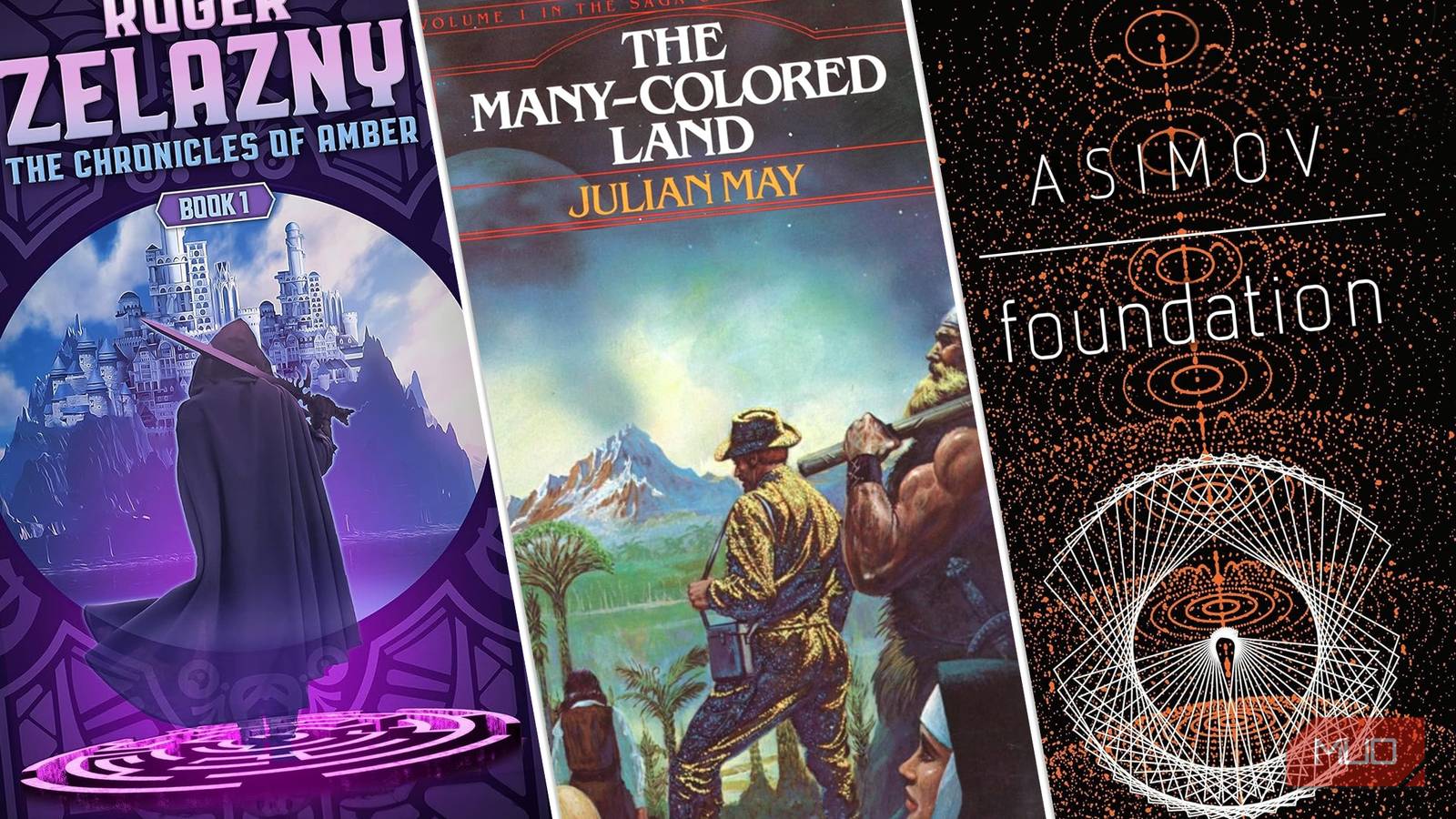
The original Foundation trilogy — Foundation, Foundation and Empire, and Second Foundation — was published in the early 1950s and tells the story of Hari Seldon, a mathematician who develops a way to predict the future of large populations. According to his theory of psychohistory, the Galactic Empire is going to collapse and plunge humanity into a dark age that will last tens of thousands of years. There’s no way to avert the crisis, but by establishing a separate civilization apart from the Empire, Seldon and his followers can at least minimize the damage.
Foundation is challenging, sweeping, and hugely influential on future authors. Isaac Asimov later wrote a pair of sequels as well as two prequels, although the original trilogy can also be enjoyed on its own.
Remembrance of Earth’s Past by Cixin Liu
2008-2010

The Remembrance of Earth’s Past trilogy is about humanity’s first contact with an extraterrestrial species… and it does not go well. The Trisolarans are determined to make Earth their new home and don’t care if they have to wipe us out to make it happen. But they’re a number of light-years away from Earth, and it will take them a while to get here, so we have time to prepare.
Netflix is currently adapting these books as the TV show 3 Body Problem, which is a great introduction to this world. The books go deeper, ask more probing questions, and get into more detail.
Saga of Pliocene Exile by Julian May
1981-1984

Saga of Pliocene Exile, also known as Saga of the Exiles, follows a group of time travelers from the 21st and 22nd centuries who travel back into Earth’s distant past…which they find already occupied by extraterrestrials. Across four novels, Julian May explores the reason these people are fleeing the future as well as how they disrupt the existing societies of the Tanu and Firvulag aliens.
The books have complex characters, deep world-building, and an intricate psychic power system that’s fun to figure out.
The Chronicles of Amber by Roger Zelazny
1970-1991

The Chronicles of Amber are a series of 10 novels set across a number of alternate realities, as the immortal royal family of Amber battles for control of the one true world as well as its infinite shadow reflections. At heart, The Chronicles of Amber feels like a high fantasy series, but the element of “shadow walking” — sliding from one reality to another — gives it a distinct sci-fi flavor.
It all adds up to a rich, imaginative, and absorbing read. The series is set into two cycles of five books each: the Corwin Cycle (Books 1-5) and the Merlin Cycle (Books 6-10).
The Broken Earth by N.K. Jemisin
2015-2017

The Broken Earth trilogy is set on the Stillness, a super-continent that regularly experiences massive, extinction-level climate events. The series follows a number of “orogenes,” people who possess the ability to manipulate seismic and tectonic energy with their minds. Orogenes are crucial to protecting society from the planet’s harsh climates, but also face systemic oppression.
Like The Chronicles of Amber, The Broken Earth trilogy fuses sci-fi and fantasy to great effect. All three books won the Hugo Award for Best Novel, marking the first time an author had won the award three years in a row.
The Horus Heresy
2006 to 2024

The Warhammer 40k universe consists of tabletop role-playing games, video games, an upcoming TV show, and hundreds of books. The Horus Heresy is a cycle of 65 novels written by various authors (according to Wikipedia, but that number does vary depending on the source!). They tell the story of a brutal civil war in the 31st century. We learn how the Emperor of Mankind’s favorite son, Horus, was corrupted by the Chaos Gods, turning half of the Imperium’s superhuman armies against their creator and teeing up the never-ending war that defines the Warhammer 40k franchise.
Warhammer 40k is only getting more popular, so it may be a good time to dive into these books, especially if you’re looking for something that will keep you occupied for a long while.
Honorable Mentions
There are, of course, other completed sci-fi series out there worth reading, plus a couple of near misses. The Dune books are obvious contenders, though complicated by the fact that the original author, Frank Herbert, wrote the first six before passing away, after which his son, Brian Herbert, picked up the thread and continued the story. But is that how Frank Herbert really wanted the series to end? We may never know.
And if somehow you run out of sprawling sci-fi sagas to read, you can always hop over to fantasy, which has its fair share of doorstopping masterworks to enjoy.