


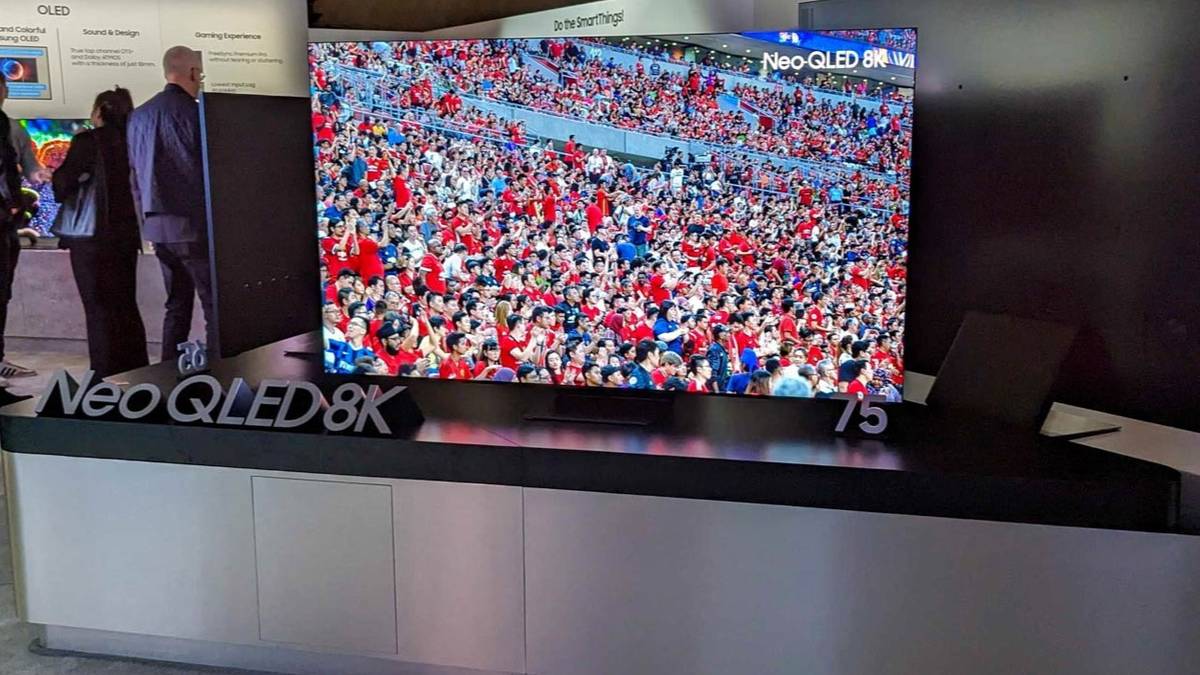
I was standing in a big-box store recently, watching a salesperson guide a couple toward a massive TV. They kept pointing at the spec tag, and the number doing most of the persuasion was not contrast ratio, HDR brightness, refresh rate, or HDMI ports. It was 8K.
I get why that works. 8K sounds futuristic in the cleanest possible way. It means 7,680 by 4,320 pixels, which is four times the pixel count of 4K. That is impressive. It is also one of the least useful numbers to obsess over when buying a TV today.
Don’t buy a TV in 2026 without these features — you’ll regret it within a year
If you’re buying a new TV in 2026, there are a few specific features you should make sure it has beyond the most obvious ones.
8K looks great on a box
But your couch has other ideas

The reason “8K” is so effective as a selling point is the same reason “more megapixels” sold cameras for a decade after the megapixel race stopped producing visible improvements. The number is concrete and easy to compare. It bypasses judgment and replaces it with arithmetic.
The problem is that resolution only matters if your eyes can actually resolve the extra detail, and at typical TV-viewing distances, they often cannot. Based on standard visual acuity calculations for a viewer with normal 20/20 vision sitting around ten feet from the screen, you would need a display somewhere in the range of 100 to 150 inches to reliably perceive the jump from 4K to 8K.
A double-blind study presented by Warner Bros. VP of Technology Michael Zink at the Hollywood Professional Association Tech Retreat in February 2020 — conducted with Pixar, Amazon Prime Video, LG, and the American Society of Cinematographers — found that increasing resolution from 4K to 8K under typical viewing conditions did not result in a statistically significant improvement in perceived image quality for viewers with normal vision seated at typical distances from an 88-inch 8K OLED.
The one meaningful caveat was that participants with sharper-than-normal 20/10 acuity, seated in the front row, did rate certain 8K clips slightly higher. If you have exceptional vision and sit closer than most people do, 8K is not entirely invisible to you. For the rest of the living room, it effectively is.
Most people are watching a 65- to 85-inch TV from 8 to 12 feet away. At those distances and screen sizes, 4K already exceeds what human acuity can fully resolve, and the incremental gain from doubling the pixel density in each direction becomes negligible. The television industry has evidently noticed this. LG has exited the 8K market entirely, discontinuing both its OLED and LCD 8K lines — its last 8K OLED, the Z3, was officially discontinued in late 2025 with no successor announced. Sony and TCL left before them.
Samsung is now the only major manufacturer still selling the best 8K TVs. It even showed unusual restraint at CES 2026, not showcasing its 8K set at all and launching its new Micro RGB backlight technology exclusively in 4K models. This, despite having debuted an 8K prototype the year before. The way Samsung continues to market its 8K lineup implies that the emphasis is almost always on upscaling performance and processing quality, not on the resolution itself.
Most 8K TVs are still eating 4K leftovers
The content pipeline did not get the memo
The practical reality is that no major streaming service currently offers native 8K content. There is no 8K Blu-ray format. Broadcast television is not transmitting in 8K. The gaming situation is similarly thin. The PS5 Pro technically supports 8K output via compressed display stream encoding, and Sony quietly dropped the 8K label from PS5 Slim packaging in 2024 (having originally promised the feature in a firmware update that never arrived), but native 8K game rendering is nowhere near mainstream. Most console gaming targets 4K at 60 frames per second, and often does not even reach that without performance-mode compromises.
What native 8K content exists is scattered across YouTube demo reels, some professional production workflows, and niche camera outputs. YouTube supports 8K uploads, and if you want to watch a drone fly over Iceland in pristine detail, the content is there. But that is not how most households watch television. They are watching compressed 4K streams on Netflix, 1080p cable sports, and HD broadcast news. An 8K TV will upscale all of it.
Upscaling matters, and I do not want to dismiss it. 8K TVs, especially Samsung’s flagship Neo QLED models, use AI-assisted processing to analyze and enhance lower-resolution signals before they reach the panel. When this works well, the result can look cleaner and more detailed than a native 4K signal on a weaker TV.
But upscaling is not a resolution upgrade; it is a processing trick that generates estimated detail. The quality of the result depends almost entirely on the quality of the underlying processor, not the pixel count of the panel. A mediocre 8K TV with weak processing can make average-quality source material look worse, not better, by adding artificial texture and false sharpening.
The better picture is usually hiding in the less exciting specs
This is where the TV actually earns its price

If you want to know what separates a good TV from a disappointing one, stop at the resolution line and keep reading.
Panel type and contrast do far more heavy lifting than an 8K logo ever will. An OLED TV can switch individual pixels off completely, giving it black levels so deep they are effectively immeasurable and creating the kind of contrast that makes dark scenes look layered instead of muddy. That shows up in shadow detail, in mixed-light scenes where bright highlights sit beside deep blacks, and in the general sense of depth and dimensionality that a flat resolution number cannot capture.
Compared to OLED displays, Mini-LED TVs take a different route, using arrays of tiny backlights grouped into local dimming zones that let them push very high brightness while still keeping darker areas under control. The best Mini-LED sets can punch well beyond 1,000 nits and even reach 2,000 nits or more in HDR highlights, making them excellent for bright rooms and specular highlights that actually look intense. In normal viewing, from the couch rather than with your nose to the screen, that difference is easier to see than 8K from across the room.
HDR performance is the other important spec that most buyers underestimate. Not all HDR is equal. A TV can support HDR10 and still deliver a flat, underwhelming image if it cannot get bright enough or control its black levels properly. A set that barely clears 300 or 400 nits is not going to show HDR the way a strong OLED or high-end Mini-LED TV can. HDR needs brightness, contrast, tone mapping, and color volume. Resolution alone does nothing for it.
Beyond those two, there is 120Hz refresh rates, motion processing to eliminate motion smoothing so it does not turn films into soap operas, accurate color modes, enough full-bandwidth HDMI 2.1 ports, Variable Refresh Rate (VRR) support for gaming, low input lag, and smart TV software that does not make you resent the remote. These are the things you feel every day. Nobody puts them in giant font on the box because “good local dimming algorithm” does not sell televisions at Costco quite like “8K.”
Buy the TV, not the pixel count
That couple in the store — if they bought the 8K TV because of that number on the tag — almost certainly ended up with something fine. But they probably left money on the table, or traded a better panel for a bigger pixel count. That trade is almost never worth making.
That is why I would take a well-specced 4K OLED over a midrange 8K TV at the same price almost every time. The 8K model wins one clean number on the spec sheet. It just happens to be the number your eyes are least likely to see from across the room.