


Luxury and smartwatches used to be an oxymoron. A gadget that needs charging every night and is outdated within a few years isn’t really a natural fit with the centuries of craftsmanship and artistry that come with mechanical watches. For a long time, the watch world treated smartwatches as public enemy number one.
Over the years, however, watch brands and fashion houses started to dabble, and began releasing smartwatches of their own. To differentiate themselves from tech brands, they use premium materials such as titanium, sapphire crystal and ceramic, and charge double, triple, or quadruple the price.
In this guide we’ve rounded up four of the most luxurious options you can buy right from big brands like Hermès, Louis Vuitton and TAG Heuer.
They aren’t all wearOS-powered Android smartwatches, we’ve got everything from a Swiss hybrid to a sports-focused tool watch.
Prices run from the high hundreds into the thousands. Read on to find out which, if any, are worth the money.

1. Apple Watch Hermès Ultra 4
Scroll to see more →
| Specifications | Apple Watch Hermès Ultra 4 |
|---|---|
| Display | 49mm case, sapphire front crystal, wide-angle always-on Retina OLED |
| Processor | Apple S11 64-bit dual-core processor |
| Battery life | Up to 50 hours of normal use, and up to 84 hours in Low Power Mode |
Apple’s partnership with Hermès has always been the most polished crossover in the category, and the Ultra 4 is its most serious yet.
It uses a grade 5 titanium 49mm case, a sapphire front crystal, an always-on OLED display, 100m water resistance and recreational diving to 40 metres. Messages and Find My via satellite arrive on the Ultra 4 only, and health features include heart rate variability tracking, a Readiness app and hypertension notifications.
Of course, all of those features appear on the regular Apple Watch Ultra 4, what’s special about the Hermès Edition is the selection of straps. One option is a satin-brushed titanium Single Tour band made in Switzerland, while others are knitted nylon made in France.
You also get a selection of exclusive watch faces, including interactive Hermès dials like Fathom, Wonder, and Maritime with depth-gauge capabilities and animated backgrounds.
The new titanium Hermès band costs $3149 / £2899, a record for an Apple Watch (if you discount the 18-karat gold Apple Watch). For comparison, Apple’s standard Ultra 4 starts at $799 / £749.
2. TAG Heuer Connected Calibre E5
Scroll to see more →
| Specifications | TAG Heuer Connected Calibre E5 |
|---|---|
| Display | 1.39in (45mm) or 1.20in (40mm) 326 ppi AMOLED |
| Processor | Snapdragon W5+ Gen 1 |
| Battery life | Up to 2 days (45 mm) / 1.5 days (40 mm) |
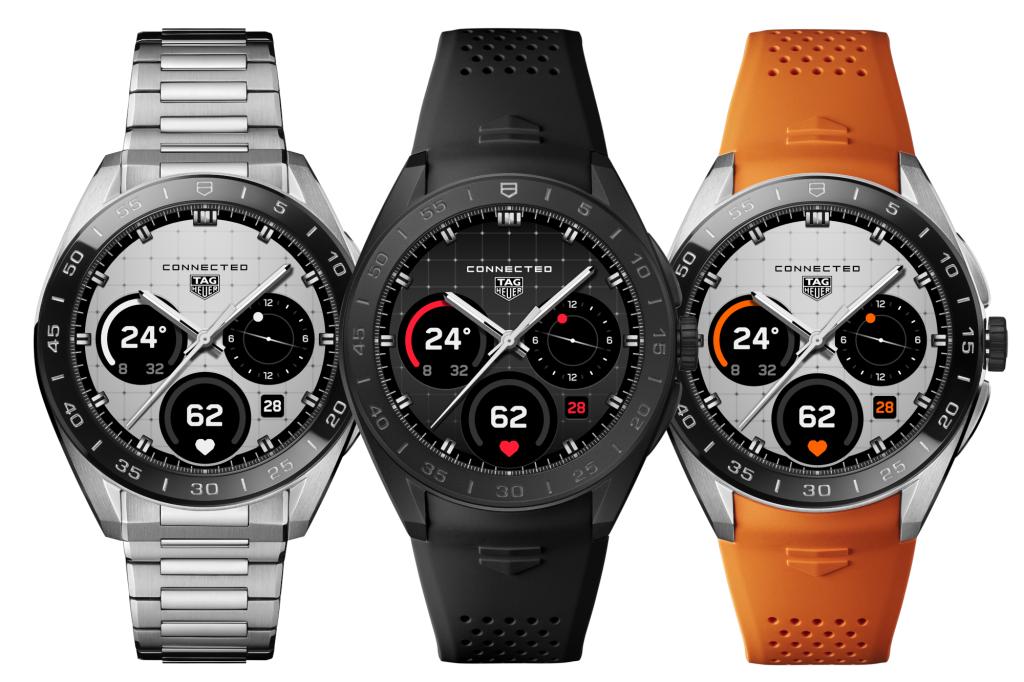
TAG Heuer was one of the very first Swiss brands to release a smartwatch (if you don’t count the Swatch Touch, which, let’s be honest, most people don’t). So it really is a pioneer in that respect. The latest version, the TAG Heuer Connected E5 is a great option for anyone who wants a proper Swiss watch brand’s name on a smartwatch (without spending Moser money).
The E5 arrived in 2025, swapped Wear OS for TAG Heuer’s own operating system, and comes in 40mm and 45mm sizes in steel or titanium.
The 45mm version has a 1.39in, 454 x 454 OLED panel under sapphire glass. It runs a Snapdragon W5+ Gen 1 chip and offers dual GPS, plus heart rate, sleep and blood oxygen sensors.
The compromises are the usual ones for a new platform – TAG Heuer OS has a smaller software ecosystem than Apple and Google’s, and it also misses features such as contactless payment.
Still, water resistance is 50m, and battery life is about 1.5 days at full performance or two in low power mode. It’s actually a really great package.
Prices for the TAG Heuer Connected E5 start at $1600 in the US and £1350 in the UK, with plenty of design options including Golf, TaylorMade, Malborn, and F1 special editions.

3. H. Moser & Cie Off-Grid
Scroll to see more →
| Specifications | H. Moser & Cie Off-Grid |
|---|---|
| Display | Small black and white digital screen |
| Processor | D10 calibre developed with Sequent |
| Battery life | 12 months in time-only mode |
The most unusual entry on this list is also the newest. The Off-Grid is a hybrid analogue-digital watch from H. Moser & Cie, a family-owned, independent, luxury Swiss watch maker. It also might be one of the most surprising watches of 2026.
It pairs a skeletonised dial and small domed sub-dial which carries the H. Moser & Cie. logo in transparent lacquer, with a digital screen at 6 o’clock.
Despite the screen, Moser has no interest in making a notification machine or fitness tracker. Under the dial sits a quartz calibre, the D10, developed with Swiss smartwatch specialist Sequent, which first appeared in Moser’s Formula 1 collaboration with Alpine.
Its feature list is very deliberately focused – you get GMT, a 1/100-second split-seconds chronograph, a perpetual calendar, perpetual moon phase, sunrise and sunset times, an alarm, a timer and a small multilingual dictionary.
Perhaps best of all, the Off-Grid, from a distance, looks just like an H. Moser Streamliner. It’s thin, beautifully made, and the rubber strap is one of the comfiest I’ve tried.
Battery life stretches to 12 months in time-only mode, or up to six with the other functions in use.
It costs CHF 3900 (about $4900), making it Moser’s most accessible watch by a wide margin. There are two colourways available, both limited to 1000 pieces and both sold out.

4. Garmin Marq
Scroll to see more →
| Specifications | Garmin Marq |
|---|---|
| Display | 46mm case with a domed sapphire lens and 1.2in AMOLED touchscreen |
| Processor | TBD |
| Battery life | Up to 16 days |
Garmin is the veteran smartwatch maker of this list, and the Marq is the only one built around serious sports tracking. The Gen 2 line is several years old now, but it still looks the part. It uses a 46mm Grade-5 titanium case, a domed sapphire lens and an AMOLED touchscreen.
Garmin describes the collection as luxury “tool watches”, and it comes in five variants themed around aviators, sailors, golfers, athletes and adventurers. The Captain, for example, adds a ceramic bezel and marine navigation features.
So how does it differ from a Fenix or Epix? Under the skin, very little. The Marq draws on the same sports and navigation platform as Garmin’s flagship outdoor watches, so you get the same depth of training metrics, mapping and multisport modes. The difference is what you’re paying for. Every Marq gets a Grade-5 titanium case, sapphire glass, and a more upmarket strap or bracelet. Fenix and Epix models are designed first as rugged, practical sports tools, and they cost considerably less.
At launch, the Marq collection ranged from $1900 / £1600 to $2400 / £2100.
If you want a watch you’d happily wear to a board meeting and then use to track a marathon, this is it. If you only care about the sports features, a Fenix or Epix will do the same job for far less.
Luxury smartwatch FAQs
The big question, but ultimately, it depends on what you value. If you value materials, design and brand heritage, models like the Hermès Ultra 4 or Moser Off-Grid deliver that. If you simply want the best tech for the money, a standard Apple Watch or Garmin will do more for far less.
The difference is mainly in the build and the brand. Luxury models use materials such as titanium, sapphire crystal and ceramic, and often come with designer straps or exclusive software features. The core tech inside is often similar to, or older than, what you’d find in a mainstream model.
Prioritise the case material, a sapphire crystal screen and decent water resistance. Then check battery life, phone compatibility and how long the software is likely to be supported. Because you’re spending so much money, it should still work in a few years’ time.
A hybrid watch pairs a traditional analogue dial with a limited set of digital features, and usually lasts months on a battery. A full smartwatch has a touchscreen, apps and always-on connectivity, but typically needs charging every day or two.

